

Let's be honest, the secret to a quilt that truly sings isn't just the fabric you so carefully chose or the perfect batting. The real magic, the element that holds it all together and defines its very character, is the thread. Welcome to the world of machine quilting, where thread is far more than just... well, thread. It's the unsung hero of your craft.
Choosing the right machine quilting thread is the difference-maker. It’s what elevates a nice quilt top into a breathtaking, durable work of art.
Beautiful Quilts Begin with the Right Thread
Think of your thread as an artistic medium, not just a utilitarian binder. The right choice can make your quilting design pop with texture and definition. The wrong one? It’s a fast track to frustration, with constant thread breaks, skipped stitches, and a finished quilt that just doesn't feel right.
This guide is designed to cut through the confusion you feel when standing in front of that giant wall of thread spools at the store.
We’re going to untangle how different materials like cotton and polyester, various thread weights, and color choices can bring your creative vision to life. Most importantly, we'll connect the dots on why matching your thread to your batting is the absolute key to getting that professional finish you're after. Whether you’re working with a lofty wool or a classic Hobbs 80/20 batting, the thread you pick has to work with it, not against it.
A great quilt is a partnership. The fabric, batting, and thread must work in harmony. When they do, you create a beautiful, lasting piece of art that tells a story for generations.
Understanding this dynamic is everything. A thick, heavy thread will bully a thin, delicate batting, causing awful puckering and tension issues. On the other hand, a super-fine thread can get completely swallowed up by a high-loft wool, disappearing into the fluff. We’ll dig into all these details so you can choose with confidence.
Here’s what we’ll cover to get you started:
- Material Matters: A real-world comparison of cotton, polyester, and blends for strength, lint, and finish.
- Weight and Definition: How thread thickness (or thinness!) directly impacts the look of your stitches.
- Color and Sheen: Deciding when to make your thread a background player and when to let it steal the show.
- Machine Considerations: Practical tips for both domestic sewing machines and longarm quilting machines.
Let's dive in and make sure every single stitch you make is one you can be proud of.
Choosing Your Thread Material: Cotton, Polyester, and Beyond
The thread you choose is so much more than just a spool of color. It's the literal stitch that holds your quilt sandwich together, and its material is a huge part of your quilt's final look, feel, and lifespan. Picking the right fiber—whether natural or synthetic—is one of those foundational decisions that really sets the stage for success.
Cotton thread is the old-school classic, and for good reason. It has a beautiful, soft matte finish that just melts into the fabric. Since it's a natural fiber, it "ages" right alongside your cotton fabrics and batting, which helps give a quilt that authentic, heirloom feel over the years. That low-sheen look is perfect when you want the quilting texture to be the star, not the thread itself.
Then you have polyester, the modern workhorse of the quilting world. This stuff is strong. It's incredibly durable, which makes it a fantastic choice for quilts that are going to be loved hard and washed often. One of its biggest selling points, especially for longarm quilters, is that it produces way less lint. That means cleaner machines and smoother quilting sessions.
The Great Debate: Cotton vs. Polyester
So, which one is right for you? It’s less about one being "better" and more about matching the thread to the project. A soft, cuddly baby quilt made with 100% cotton batting practically begs for a gentle cotton thread. But if you're making a quilt for a college dorm room, polyester’s strength is going to be your best friend.
It’s no surprise that the global sewing thread market, which includes the machine quilting thread we rely on, is growing. It's projected to expand from USD 2.29 billion in 2025 to USD 3.18 billion by 2034. And get this—synthetic threads like polyester make up a whopping 80% of that market, largely because they're so strong and hold their color so well. You can dive deeper into sewing thread market trends to see how these materials are driving the industry.
Key Takeaway: Go with cotton when you want a soft, traditional finish that blends beautifully. Pick polyester when you need serious strength, low lint, and a bit of sheen—it's a longarmer's dream.
Other Materials to Consider
Cotton and polyester might be the headliners, but a few other materials offer some really cool creative options.
- Rayon: This thread is all about that brilliant, high-gloss shine. If you want your stitching to pop and become a major design feature, like in decorative work or embroidery, rayon is your go-to.
- Silk: Don't let its delicate look fool you; silk thread is remarkably strong. It's exceptionally fine, creating gorgeous, detailed stitches with a subtle luster that adds a touch of elegance without being flashy. It’s perfect for heirloom quilting.
The chart below breaks down the key players to help you match the right thread to your next project.
Comparing Machine Quilting Thread Materials
| Thread Material | Key Characteristics | Best For | Ideal Batting Pairing |
|---|---|---|---|
| Cotton | Soft, matte finish, low stretch, ages with fabric. | Traditional quilts, heirloom projects, achieving a "crinkly" antique look. | 100% Cotton, 80/20 Cotton/Poly Blends |
| Polyester | Strong, durable, low lint, slight sheen, colorfast. | Quilts for heavy use, longarm quilting, when stitch definition is key. | 80/20 Blends, Polyester, Fusible Batting |
| Rayon | High sheen, brilliant color, not as strong as polyester. | Decorative stitching, machine embroidery, anywhere you want the thread to shine. | Wool, Polyester (for quilts not washed frequently) |
| Nylon | Very strong, can be transparent (monofilament). | "Stitch in the ditch" quilting, invisible appliqué, utility quilts. | Any batting where you want the stitches to disappear. |
Ultimately, the thread you choose works in partnership with your fabric and batting. It's not just a standalone supply; it's the central element that pulls everything together.
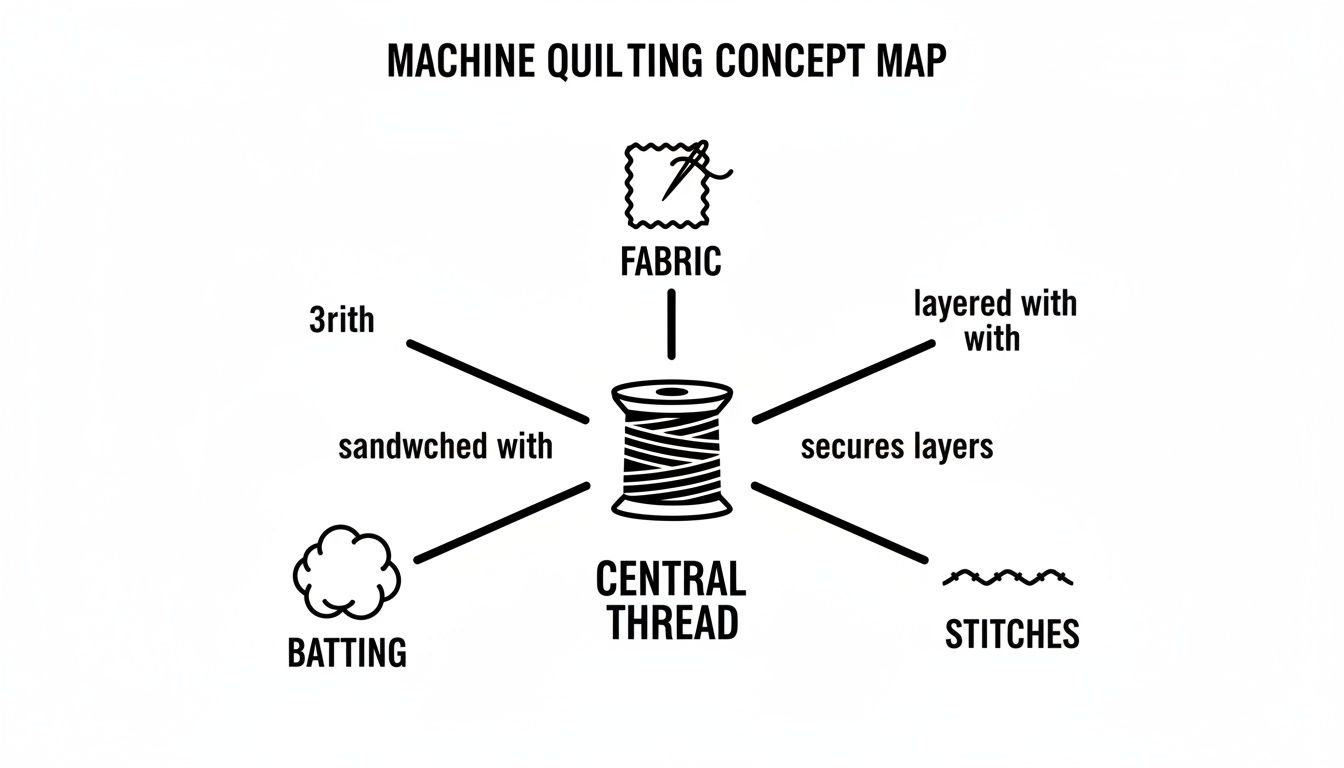
As this visual shows, a great quilt happens when the thread, fabric, and batting are all working in harmony. Your choice of thread is what makes that connection a success.
Understanding Thread Weight and Why It Matters
When you're choosing a machine quilting thread, it's easy to get lost in a rainbow of colors. But the real magic lies in its thickness, or weight. Getting a handle on thread weight is one of the most powerful things you can do to control the final look of your quilt.
It can feel a bit technical at first, but it all boils down to one simple, if slightly backward, rule.
The higher the number, the finer the thread.
That’s it. A 100-weight (100wt) thread is whisper-thin, almost like a strand of hair, making it perfect for stitches you want to disappear. On the flip side, a chunky 12wt thread is bold and demands attention. Once this clicks, you've unlocked the secret to making your quilting stitches do exactly what you want.
Most of us live in the world of 50wt thread. It’s the reliable workhorse of the quilting studio, perfect for both piecing your quilt top and for most general quilting. It creates a clean, defined stitch that lets your piecing shine without stealing the show. If you're looking for a go-to, the fantastic range of Aurifil 50wt cotton threads is a staple for a reason.
Choosing Thread Weight for Your Design
Think of thread weight as the volume knob for your quilting. Do you want your stitches to shout or to whisper? This choice turns your thread from a simple fastener into a key part of your design.
-
For Stitches that Pop: If you want your quilting lines to be a star feature, grab a heavier, lower-number thread. A 40wt or even a bold 30wt will create a gorgeous, textural line that stands out. This is perfect for emphasizing graphic quilting patterns or echoing around appliqué.
-
For Texture that Blends: Sometimes, you want the pillowy texture of the quilting to be the main event, not the stitches themselves. For that, you need a fine thread. A 60wt is more subtle than the standard 50wt, and an ultra-fine 100wt thread all but vanishes into the fabric, creating that beautiful "invisible quilting" effect.
Pairing Thread Weight with Your Batting
Your thread and your batting need to be good partners. If they aren’t working together, you can end up with frustrating puckers, wonky tension, and a quilt that just won’t lay flat.
Imagine trying to quilt with a thick rope over a delicate, thin piece of batting. It's a recipe for disaster. The heavy thread will pull and cinch that lightweight foundation, distorting your beautiful work.
Here’s how to make a perfect match:
-
Lofty Batting (Wool, High-Loft Poly): These puffy, resilient battings can easily handle the drama of a heavier thread. A 40wt or 30wt looks incredible here, as the batting’s fluffiness supports the thick thread and creates deep, luxurious quilting definition.
-
Low-Loft Batting (100% Cotton, 80/20 Blends): Flatter battings like these are happiest with standard or finer threads. A 50wt or 60wt is the sweet spot. They won’t overpower the batting, giving you a lovely, smooth finish without any puckering.
By thinking about how your thread weight, design goals, and batting choice all connect, you gain total control over the look and feel of your finished quilt.
Matching Needles and Tension for Perfect Stitches
You can have the most beautiful, high-end machine quilting thread in the world, but it’s doomed from the start if you pair it with the wrong needle or wonky tension. I like to think of the needle, thread, and machine as a three-person team. If one member isn't pulling their weight, the whole project falls apart. In fact, a mismatched needle is hands-down the biggest reason for shredded thread and skipped stitches.
This is a lesson more and more people are learning as quilting continues to boom. The quilting world is huge, with an estimated 9-11 million of us stitching away globally. What's really exciting is that recent surveys show nearly 18% of quilters are brand new to the craft. As our community grows, getting these fundamentals right becomes more important than ever. You can actually see more on the growth of the quilting market and its trends to get a sense of just how much it's expanding.
Choose the Right Needle for Your Thread
A needle has one critical job: to punch a clean hole through the quilt sandwich and guide the thread through it without causing any drama. To do that smoothly, different thread weights need different needles.
-
For 50wt Thread (The All-Rounder): An 80/12 Universal or Quilting needle is your best friend. It has a slightly rounded point that does a beautiful job of getting through all those layers of fabric and batting.
-
For 40wt Thread (A Bit Thicker): When you move up in thread size, you need to move up in needle size. Grab a 90/14 needle. The bigger eye gives that thicker thread more room to breathe, preventing friction and fraying as it flies through your machine.
-
For 12wt Thread (The Showstopper): For this extra-thick thread, you need a heavy-hitter like a 100/16 Topstitch needle. These needles are specially designed with a giant eye and a deep groove along the shaft to protect those gorgeous, chunky threads from getting chewed up.
And please, always start a new quilt with a fresh needle! They’re cheap, and swapping one out can save you from a world of frustration. They get dull way faster than you think, which leads to snagged fabric and skipped stitches. For a deeper dive, check out our guide on choosing the right sewing needles for your projects.
Pro Tip: If your thread starts shredding or breaking, stop what you're doing and change the needle. I'm not kidding—this one simple trick solves the problem more than 90% of the time.
The Art of Perfect Thread Tension
When your tension is perfect, you don't even notice it. It’s that sweet spot where the top and bobbin threads meet right in the middle of the batting, creating stitches that look identical on both the front and the back. When it’s off, the problems are obvious.
-
Loops on the Back ("Eyelashing"): Seeing little loops of your top thread on the quilt back? That's a classic sign your top tension is too loose. The bobbin thread is yanking the top thread all the way through. Just nudge the top tension dial to a slightly higher number.
-
Bobbin Thread on Top: If you see tiny dots of bobbin thread poking through on your quilt top, your top tension is too tight. Your top thread is winning the tug-of-war. Turn the tension dial to a slightly lower number to loosen it up.
The key is to always test on a practice quilt sandwich before you touch your actual project. Make one small adjustment at a time until you dial it in. Getting that beautifully balanced stitch is what gives a quilt that polished, professional look we all strive for.
Thread Strategies for Longarm vs. Domestic Machines
The machine you quilt on—whether it's a trusty domestic model or a high-speed longarm—plays a huge part in which thread will work best for you. While they both lay down a stitch, the way they do it is worlds apart. Think of it like a family sedan versus a Formula 1 race car. They're both cars, but they run on completely different fuel and operate under totally different stresses.
A longarm quilting machine is an absolute workhorse, built for speed and endurance. These machines fly across a quilt top, generating a ton of friction and heat that can absolutely shred a weaker thread. This is exactly why so many longarm quilters swear by high-tenacity, low-lint polyester threads. They’re engineered to take that punishment without breaking or fraying, saving you from the headache of constant thread breaks and keeping your machine's guts clean from lint buildup. If you want to learn more about what makes these machines so unique, check out our in-depth guide to longarm quilting.
Domestic Machine Thread Choices
For those of us quilting on a domestic machine, versatility is usually the name of the game. You want a reliable thread that can handle everything from piecing to free-motion quilting without a fuss. A high-quality 50wt cotton or a silky smooth polyester is often the perfect all-rounder, giving you beautiful stitches without needing a specialized setup. Your machine runs at a more manageable pace, so it’s generally more forgiving.
Spools vs. Cones: A Practical Decision
Another big difference comes down to how you buy your thread. Quilters on domestic machines often buy thread on spools, which hold a few hundred yards. This is great for smaller projects or when you're building a rainbow of colors for different tops.
But for serious quilters, and especially for longarm studios, buying thread on large cones is a total game-changer.
Cones are the bulk purchase of the thread world. Buying a cone of your favorite neutral quilting thread is like buying batting by the roll—it’s more cost-effective, ensures color consistency across huge projects, and means you spend less time changing spools and more time quilting.
The quilting machine market is booming, valued at a whopping $1.2 billion in 2024, which just shows how many quilters are investing in these powerful tools. Longarm machines own the largest slice of that pie thanks to their incredible efficiency, making bulk supplies like thread cones a must-have for any serious quilter or studio. With North America leading the charge at 36% of the global market, it's clear that more and more quilters are adopting these professional-level strategies. You can read more about the quilting machine market's growth and see how it’s shaping the supplies we use.
How to Build Your Machine Quilting Thread Collection
Walking down the thread aisle can feel overwhelming. It’s a beautiful rainbow of potential, but building a collection that actually works for you is about smart choices, not just grabbing every color that catches your eye. Let's talk about how to build a stash that serves you project after project.
The very first thing to think about is what you want your stitches to do. Are they a quiet, textural element that sinks into the fabric? Or are they a bold, graphic statement meant to be seen? This one decision completely changes your approach and sets the tone for the entire quilt.
Start with a Neutral Foundation
Before you get lost in a sea of vibrant reds and blues, lay down a solid foundation of neutrals. This is, without a doubt, the smartest and most economical way to start. You’ll be shocked at how many quilts you can finish with just a handful of workhorse colors.
Your go-to neutral palette should absolutely include these basics:
- Cream or Off-White: The MVP for light-colored fabrics and low-volume backgrounds.
- Beige or Tan: A warm, friendly neutral that plays beautifully with medium-value prints and batiks.
- Medium Grey: This is the secret weapon. Grey is a master of disguise, blending into an incredible range of colors without drawing attention to itself. It just works.
Start with these three core colors in a good-quality 50wt, and you'll be set for over 80% of the quilts that come your way. This reliable foundation lets you splurge on those fun, project-specific colors when you need them, not just because you think you should have them.
Quality and Storage Matter
Once your neutrals are in place, the fun begins! As you start adding more colors, make quality your number one priority. A good machine quilting thread is smooth, has very little lint, and won't shred or break on you. This means less frustration, cleaner stitches, and a happier sewing machine. A quick look at the spool can tell you a lot—it should look uniform, tightly wound, and have a healthy sheen.
Finally, think about how you're storing your thread. It’s an investment, so protect it! Keep your spools out of direct sunlight, which can make the fibers brittle and fade the color. Storing them in a covered container also keeps dust off, which is crucial because dust can get pulled right into your machine’s tension discs and cause problems.
Building your thread library is a marathon, not a sprint. By being intentional with your choices, you'll create a stash that inspires you and supports your creativity for years to come. When you're ready to add to your toolbox, explore our extensive collection of quilting threads to find your next perfect spool.
Your Top Machine Quilting Thread Questions, Answered
Let's be honest, even after years of quilting, thread can still throw you a curveball. It’s one of those things that seems simple on the surface, but the details really matter. We get a lot of the same questions time and again, so let’s walk through them and get you quilting with confidence.
First up, the big one: "Can't I just use my regular all-purpose sewing thread?" In a real pinch, maybe. But I wouldn't recommend it. That all-purpose thread is great for piecing a shirt, but it just wasn't built for the high-speed, high-friction world of machine quilting. You'll likely end up with a mess of shredding, breaking, and a whole lot of unnecessary lint.
Here's the inside scoop: True quilting thread is engineered to be a workhorse. It’s designed with a special finish to glide smoothly through multiple layers at high speeds, which means less friction, less breakage, and a stitch that’s both beautiful and incredibly strong.
Tackling Those Pesky Thread Problems
So, what do you do when your thread starts shredding or snapping mid-quilt? Before you even think about touching that tension dial, I want you to do one thing: change your needle. I can’t tell you how many times this is the culprit. A dull, slightly bent, or wrong-sized needle is the #1 enemy of good stitches. Your thread needs to pass through the needle's eye without a fight.
Another question I hear all the time is about matching the thread in the bobbin to the thread on top. And the good news is, you absolutely don't have to! In fact, using a finer thread in the bobbin is a fantastic pro-level trick. Try a lightweight 60wt or even an 80wt polyester. It dramatically reduces bulk on the back of your quilt, helps you dial in that perfect tension, and—my personal favorite—lets you pack way more thread onto a single bobbin.
How to Choose the Perfect Color
Okay, let's talk about the fun part: color. Picking the right thread color really comes down to what you want to achieve with your quilting.
- Want the stitches to disappear? If your gorgeous fabric is the star of the show, pick a thread that blends right in. A nice medium grey is a secret weapon for many quilters; it has a chameleon-like ability to melt into a surprising number of colors.
- Want your quilting to pop? When your stitching is a deliberate design element, go for it! A bold, contrasting color turns your quilting into its own art form and adds an incredible layer of texture and personality.
- Want something in between? This is where variegated threads shine. The way the color shifts along the strand adds a beautiful, subtle energy and movement to the quilt without being overwhelming.
Getting these basics down really is the key to a smoother, more enjoyable quilting experience.
At Quilt Batting, we know that pairing the right supplies is what turns a good quilt into a great one. When you're ready to match that perfect thread to the perfect foundation, check out our premium selection of batting and quilting essentials. You can find everything you need for your next project at https://quiltbatting.shop.