

If you've ever wrestled a big quilt through the tiny opening of your home sewing machine, you know the struggle is real. Shoving and pulling all that fabric through that small space—the throat—can suck the joy right out of finishing your beautiful quilt top.
That's where the magic of longarm quilting comes in.
The Secret to Finishing Quilts Without the Struggle
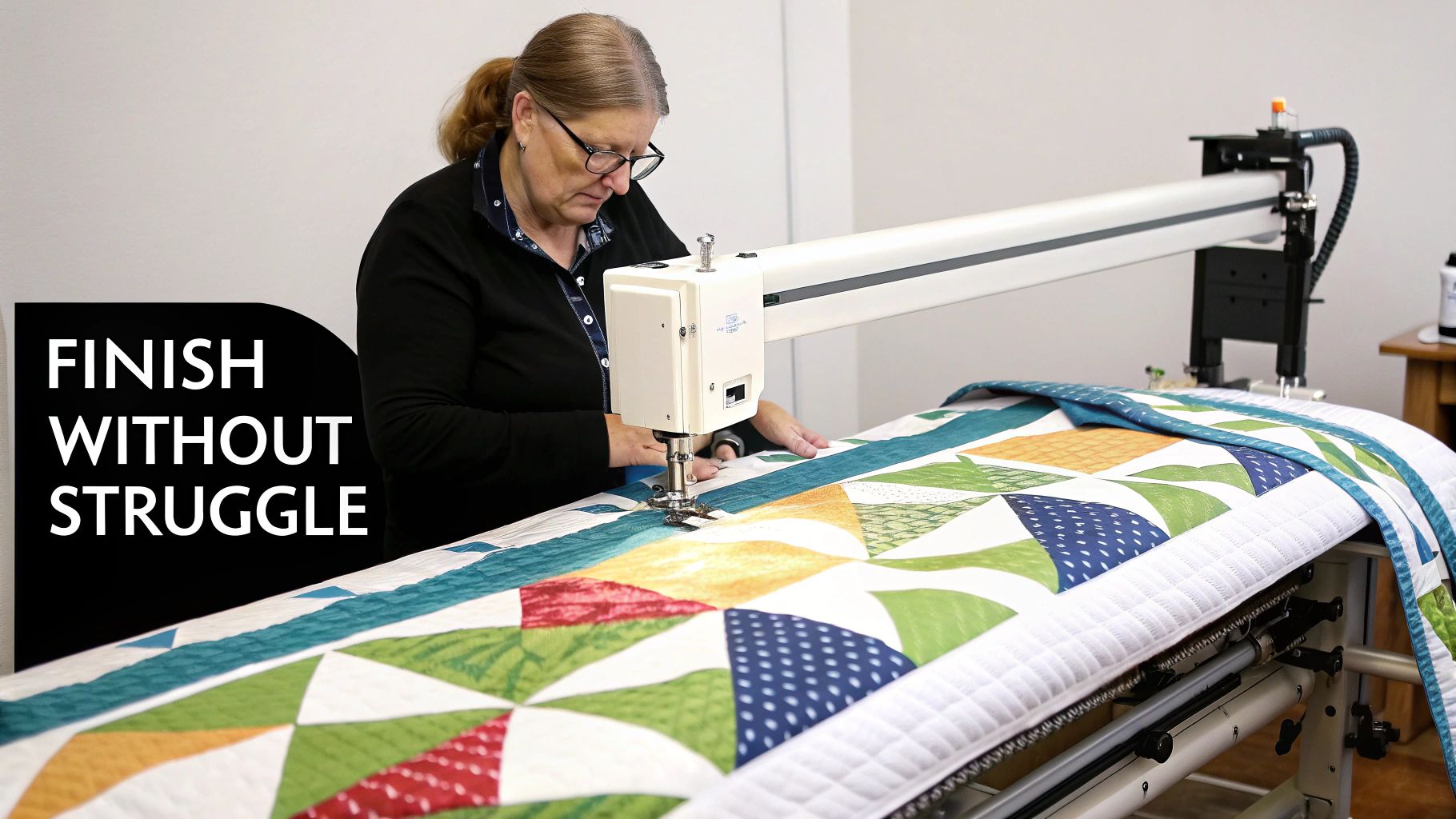
Picture a totally different way of working. Instead of you fighting to move a heavy quilt, a large sewing machine head glides smoothly over the fabric. Your quilt top, batting, and backing are stretched perfectly flat and taut on a huge frame, creating the ideal canvas for your stitches.
From there, you just guide the machine, almost like you're drawing with thread. The movements are fluid and painterly, letting you create stunning, intricate designs with ease.
Flipping the Script on Quilting
This simple shift is the heart of what makes longarm quilting so different. It completely flips the process on its head, freeing you from the physical strain of quilting on a domestic machine and letting you work on a massive scale. It's less of a machine and more of a powerful creative partner.
The core concept is simple yet powerful: the machine moves while the quilt remains stationary. This single change unlocks a new level of control, speed, and artistic freedom that domestic machines just can't touch.
This setup makes quilting large projects not just doable, but genuinely fun. That final, often-dreaded step of the quilting process becomes a chance to really let your creativity shine, turning a necessary task into a true art form.
Why It Matters for Every Quilter
Whether you're thinking about buying a machine yourself or sending your quilt tops out to a professional, it pays to understand what longarm quilting is all about. It really is the gold standard for finishing a quilt, giving any pieced top that polished, professional look. The benefits are impossible to ignore:
- Superior Stitch Quality: Most longarms have stitch regulators, which means every single stitch is perfectly uniform and beautiful.
- Speed and Efficiency: A longarmer can finish a king-sized quilt in just a few hours, not the days or weeks it might take you at home.
- Artistic Potential: This is where it gets exciting! You can do anything from simple all-over (edge-to-edge) designs to incredibly elaborate, custom artwork.
- Reduced Physical Strain: Say goodbye to the back and shoulder pain that comes from wrangling a big quilt through a small machine.
Of course, a quilt has to be properly prepared before it ever gets loaded onto a longarm frame. While the machine does the heavy lifting, those initial steps are still critical. Understanding the basics of how to baste a quilt gives you great insight into how the three layers work together, which helps you appreciate just how efficient the longarm process really is. With that foundation, you’re ready to dive into the machines and methods that make it all happen.
What Exactly Is a Longarm Quilting Machine?
To really get what longarm quilting is all about, you have to look at the machine itself. A longarm isn’t just a bigger sewing machine; it's a whole integrated system where three major parts work together. This setup is what makes it a completely different beast from the domestic machine you have at home.
The entire system is built on one brilliant idea: the machine head moves over the fabric, while your quilt stays perfectly still and flat. Think about that for a second. It's the total opposite of shoving and pulling a heavy quilt through the tiny throat space of your home machine.
That single difference is the secret sauce behind the smooth, gorgeous, and consistent stitches you see on even the biggest quilts.
The Three Core Components
Every longarm quilting system, no matter the brand, is made of the same three essential parts. Each one has a specific job to do, making sure the quilt is held securely and stitched perfectly from one end to the other.
- The Longarm Head: This is the heart of the operation—an industrial-strength sewing machine. It has a massive throat space, often 18 to 30 inches or more, and is built for high-speed stitching with flawless tension.
- The Frame: The backbone of the system is a huge, sturdy frame, typically 8 to 14 feet long. It holds a set of rollers that keep your quilt top, batting, and backing layers separate and under just the right amount of tension.
- The Roller System: This is where the magic happens. The rollers let the quilter advance the quilt smoothly as each section is finished, so you never have to unpin or re-baste. Everything stays taut and wrinkle-free.
These powerful setups didn't just appear out of nowhere. They were born from the quilting explosion of the late 20th century. As more and more people fell in love with the craft, they needed a better way to finish their quilts. This demand led to the invention of these specialized machines, finally solving the age-old struggle of wrestling a king-sized project through a tiny machine. You can read more about this evolution and its effect on the quilting industry's growth.
Hand-Guided vs. Computerized Systems
Once you get the basic setup, the next thing to understand is who—or what—is doing the driving. Longarm machines fall into two main camps, and each one offers a totally different quilting experience.
A hand-guided or freemotion system puts you in complete control. You stand at the machine and physically move the head across the fabric using handles, essentially drawing your designs with thread. This is where you get ultimate artistic freedom for organic, one-of-a-kind patterns. You can also use special tools for more controlled work; our guide on longarm quilting with rulers shows how you can create perfect lines and geometric shapes this way.
The Bottom Line: Hand-guided quilting is like freehand drawing with thread—it's all about your personal touch. Computerized quilting is like digital design—it delivers absolute perfection and repeatability.
On the flip side, a computerized system uses software to stitch out complex, pre-programmed designs with inhuman precision. The quilter chooses a digital pattern, sets it up, and the machine executes it perfectly. This is the go-to for intricate, all-over patterns (often called edge-to-edge or E2E) where you need every stitch to be identical.
Hand-Guided vs. Computerized Longarm Systems
Choosing between a hand-guided and a computerized system really comes down to what you want to achieve with your quilting. One offers pure creative freedom, while the other provides flawless precision. Here’s a quick breakdown to help you see the difference.
| Feature | Hand-Guided (Freemotion) | Computerized (Stitch-Regulated) |
|---|---|---|
| Creative Control | Maximum artistic freedom; you are the artist. | Designs are software-driven; you are the director. |
| Precision | Skill-dependent; your consistency improves with practice. | Perfect, repeatable patterns with flawless stitches. |
| Speed for Custom | Slower for one-of-a-kind, intricate designs. | Much faster for complex, all-over patterns. |
| Typical Use Case | Custom quilting, heirloom work, artistic expression. | Edge-to-edge designs, geometric patterns, production work. |
Ultimately, many professional quilters use systems that can do both. They might use the computer for a fast and perfect edge-to-edge design on one quilt, then switch to hand-guided mode for a special, custom project the next day. It’s all about having the right tool for the job.
A Quilt's Journey Through the Longarm Process
So, how does a finished quilt top become a beautifully quilted work of art? It’s a bit of a journey, and every step is just as important as the stitching itself. Good preparation is the key to a professional finish, preventing any puckers or tucks that can ruin the final look.
Think of it this way: a painter would never start on a loose, wrinkled canvas. In the same way, a longarmer needs a perfectly prepared quilt to work their magic. The process actually starts long before the machine's needle ever touches the fabric.
The Foundation: Preparation and Loading
The first, and I'd argue most critical, step is getting the three layers of your quilt sandwich ready. Your quilt top needs to be pressed perfectly flat, with all seams secure and every stray thread trimmed. If you leave loose threads, the longarm's hopping foot will find them, causing snags or nasty thread nests on the back of your quilt.
Your backing fabric is just as important. It has to be squared up and at least 4-6 inches larger on all four sides than the quilt top. We call this extra material "overage," and it's absolutely essential for attaching the backing to the frame's rollers and clamping the sides to keep everything under even tension.
Once everything is prepped, the layers are loaded onto the longarm frame one at a time:
- The Backing: This layer gets attached to two separate rollers and stretched taut until it's perfectly smooth.
- The Batting: Next, the batting is laid evenly right on top of the backing fabric.
- The Quilt Top: Finally, the quilt top is carefully positioned and attached to its own dedicated roller.
This meticulous, layered loading process is the secret sauce for a flawless finish. It sets up the perfect tension needed for the machine to glide across the surface without distorting your beautiful pieced design.
This diagram breaks down the core components, showing how the frame, rollers, and machine work together.
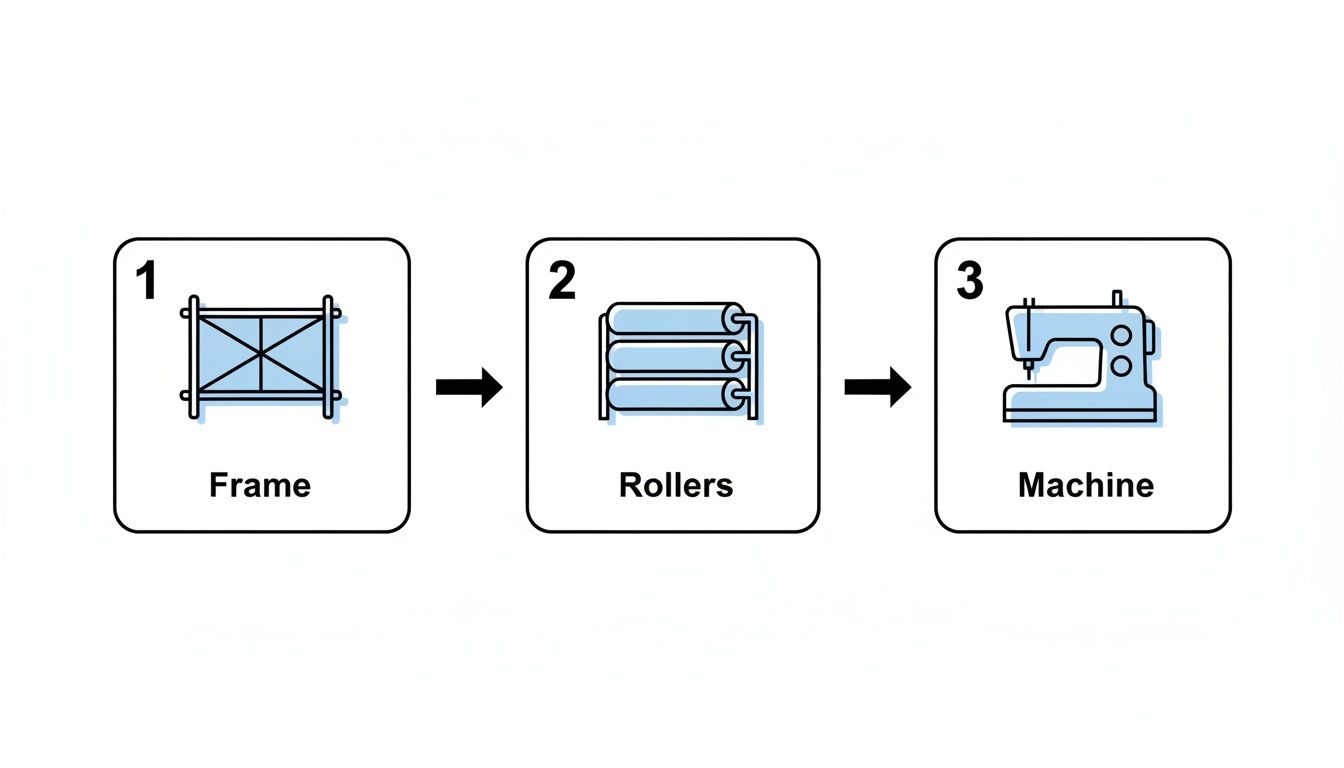
You can see how the frame holds everything in place while the rollers and machine head work as one integrated system to manage the quilt layers.
From the First Stitch to the Final Advance
With the quilt loaded and tensioned, the real fun begins. The longarmer works across the quilt from top to bottom in horizontal sections. Each "pass" is typically as deep as the machine's throat space allows.
For a hand-guided quilter, this is where pure artistry takes over. They might use rulers for crisp geometric patterns or move the machine free-hand to draw flowing, organic designs across the fabric. It’s a skill that takes a ton of practice, just like any other artistic medium.
A great longarm quilting design should complement the quilt's piecing, not compete with it. The goal is to add texture and dimension that brings out the best in the work.
If the quilter is using a computerized system, they'll program a digital pattern, often called a pantograph or an edge-to-edge (E2E) design. The machine then stitches this pattern flawlessly across the entire quilt. This method is incredibly popular for its consistency and speed, giving a polished, cohesive look that ties the whole quilt together. You can see how this compares to other techniques by exploring our guide on straight-line quilting on a home machine.
After one full horizontal pass is complete, the quilter advances the rollers. This rolls up the finished section and brings a new, unquilted area into the workspace. This process is simply repeated, pass after pass, until the entire quilt is stitched, revealing a beautifully textured piece that's finally ready for binding.
Choosing the Right Batting for Your Project
If the quilt top is the star of the show, the batting is the heart. It’s that hidden middle layer that gives your quilt its warmth, its drape, and that cozy, tactile feel we all love. While batting is important in any quilting method, its role becomes absolutely critical on a longarm machine.
Think of it this way: the wrong batting can fight you every step of the way, resisting the machine's tension and creating puckers. But the right batting? It works in perfect harmony with your stitches, turning a good quilt into a breathtaking one.
Why Longarmers Love Batting on a Roll
When you're working on a massive quilting frame, consistency is everything. This is precisely why you'll see professional longarmers and serious hobbyists gravitate toward batting that comes on a huge roll. Trying to piece together smaller, pre-packaged batts is a recipe for frustration—it's time-consuming and introduces seams that can create weird bumps or weak spots in the finished quilt.
A continuous roll gives you a flawlessly smooth, even surface from one edge of your quilt to the other. No seams to navigate, no surprising thin spots, no drama. This predictability is the secret to maintaining consistent thread tension across the entire project, which is non-negotiable for achieving those crisp, pucker-free results.
For a professional, efficiency is money. Longarmers overwhelmingly prefer bulk batting—think 96"–120" wide rolls in 15-, 30-, or even 40-yard lengths. Why? Because they can slash wastage by 10–20% compared to piecing smaller batts, not to mention the significant time saved during loading.
It’s a simple calculation: less waste and less setup time mean quilters can move from one beautiful project to the next that much faster.
Matching the Batting to Your Vision
Choosing the right batting goes way beyond just picking a material. It's about deciding on the final character of your quilt. The three most popular choices in the longarm world each bring something unique to the table, and knowing the difference is key to making your stitches truly sing.
- 80/20 Cotton-Poly Blend: This is the undisputed workhorse of the longarm studio. You get the soft, natural feel of cotton blended with the strength and subtle loft of polyester. It creates a quilt that drapes beautifully and can stand up to years of use and washing.
- 100% Cotton with Scrim: If you're chasing that classic, flat, heirloom look, this is your batting. The "scrim" is an ultra-thin mesh-like layer that’s needle-punched into the cotton, giving it stability and preventing it from stretching or distorting on the frame.
- 100% Wool: Want your quilting stitches to practically leap off the fabric? Wool is the answer. It has a higher loft that creates incredible texture and stitch definition. Plus, it’s surprisingly lightweight and offers amazing warmth without the bulk.
Of course, this is just the beginning. To really get into the weeds, our guide on the different types of quilt batting is a fantastic resource for exploring all your options.
Understanding Loft and Scrim
You’ll hear two words thrown around a lot in the batting aisle: loft and scrim. Once you understand these, you'll be able to choose your batting with total confidence.
Loft is simply the batting's thickness and fluffiness.
- Low loft batting (like 100% cotton) creates a flat, traditional-style quilt. It lets your piecing and fabric choices take center stage.
- High loft batting (like wool or some polyesters) gives the quilt more puff and dimension, making the quilting stitches a major design feature.
Scrim is a very thin stabilizer that’s integrated into the batting fibers.
- Batting with a scrim is wonderfully stable. It won't stretch on the frame and you can place your quilting lines farther apart. This reliability makes it a huge favorite among longarmers.
- Batting without a scrim is incredibly soft and drapes like a dream, but it needs a little more TLC. It requires denser quilting to keep the fibers from shifting or separating over time.
By thinking about how loft and scrim work together, you can perfectly tailor your choice to your quilt top and the quilting design you have planned. Whether you want a crisp, modern finish or a soft, cuddly drape, the right batting is what makes it happen. It’s the unsung hero that truly brings your vision to life.
So, you've pieced a beautiful quilt top. Now comes the big question: how do you finish it? Do you wrestle it through your trusty home sewing machine, or do you hand it over to a longarm quilter? It's a classic quilter's dilemma.
Your home machine is right there, ready to go, and perfect for those smaller projects you want to see through from start to finish. But let's be honest—the moment you start working on a queen or king-sized quilt, that little machine can feel less like a partner and more like an opponent.
This is where understanding the real-world differences between the two methods makes all the difference. While your domestic machine offers convenience, a longarm brings a level of speed, polish, and sheer physical relief that's in a completely different ballpark. It’s not just about the size of the machine; it’s about turning the quilting process from a back-breaking chore into a fluid, creative dance.
The Great Throat Space Debate
If you only look at one thing, look at the throat space—that’s the open area to the right of the needle. Your home machine probably has 5 to 8 inches of it. A longarm? We're talking a massive 18 to 30 inches.
Now, picture yourself quilting a king-sized quilt. On your home machine, you're trying to shove over 100 inches of fabric, batting, and backing through that tiny gap. It’s a constant battle of rolling, smooshing, and repositioning that makes your shoulders and back scream.
A longarm completely sidesteps this fight. Your quilt is loaded onto a frame, lying perfectly flat and smooth, while the machine head glides over the top. The struggle is just... gone. This freedom doesn't just save your body; it opens up a new world of creative possibility. You can stitch huge, sweeping designs without stopping every ten seconds to bunch up the quilt, leading to more ambitious and beautiful quilting.
Stitch Quality and That Professional Polish
Here’s one of the biggest reasons quilters turn to longarms: the flawless stitch quality. The secret weapon is the stitch regulator, a brilliant piece of tech that syncs the machine's speed with your movements.
What does that actually mean for your quilt? It means every single stitch is perfectly even. Every. Single. One. Whether you're stitching a gentle curve or a sharp corner, the stitch length remains identical. This creates that crisp, professional finish that's nearly impossible to replicate with free-motion quilting on a domestic machine, where you're solely responsible for coordinating your hands and the foot pedal.
Let's be real: mastering consistent stitches in domestic free-motion quilting takes years of practice. A longarm's regulated stitches give you that perfection right out of the gate. It's the single biggest thing that gives a longarmed quilt that high-end, gallery-worthy look.
Speed, Efficiency, and Thinking Big
Let's talk about time. Quilting a bed-sized project on your home machine can easily eat up days, if not weeks. A skilled longarmer can stitch up that same quilt in just a few hours.
This incredible efficiency isn't just because the machine is faster. The whole system is built for it. The quilt is loaded onto rollers, which means no more crawling around on the floor spray-basting or spending hours pinning hundreds of pins. For anyone who wants to finish more than a couple of quilts a year—or for those running a quilting business—the longarm is the undisputed champion.
Feature Comparison Longarm vs Domestic Quilting
To really see the difference, it helps to put them side-by-side. This quick comparison breaks down where each method shines, helping you decide whether to tackle your next project yourself or call in a pro.
| Aspect | Longarm Quilting | Domestic Machine Quilting |
|---|---|---|
| Workspace | Massive throat space (18-30"+); quilt remains stationary on a frame. | Limited throat space (5-8"); you move the heavy quilt. |
| Stitch Quality | Stitch regulators ensure perfectly even, consistent stitches for a professional look. | Stitch consistency depends entirely on operator skill and speed control. |
| Speed | Extremely fast; a large quilt can be finished in a matter of hours. | Significantly slower; a large quilt can take days or weeks. |
| Project Size | Ideal for any size, especially large quilts like queen and king. | Best for smaller projects like baby quilts, wall hangings, and table runners. |
| Physical Effort | Minimal physical strain; the machine glides effortlessly. | High physical strain; can cause back, neck, and shoulder pain. |
At the end of the day, there's a place for both in every quilter's toolbox. Your domestic machine is your go-to for piecing and for quilting smaller, more intimate projects. But when you’ve poured your heart and soul into a masterpiece quilt top, a longarm service provides the stunning, professional finish it deserves—saving you a world of time, effort, and frustration in the process.
Your Longarm Quilting Questions Answered
Alright, we've covered the machines, the process, and the materials. Now, let's get down to the nitty-gritty questions that pop up when you're thinking about sending your precious quilt top off to a professional. For many quilters, handing over their work for the first time can feel like a huge leap of faith.
But once you pull back the curtain, you’ll see it’s a straightforward and incredibly rewarding way to give your projects that stunning, professional finish they deserve. Let's tackle the final pieces of the puzzle, from pricing to prep work, so you can feel confident taking that next step.
How Does Longarm Pricing Work?
This is usually the first question on everyone's mind: "So, what's this going to cost me?" While every longarm quilter sets their own rates, the basic formula is pretty universal across the industry. Most of the time, you'll be charged by the square inch.
It’s simple math. Just multiply the length of your quilt by its width to find the total square inches. For example, a quilt that is 60 inches wide and 80 inches long comes out to 4,800 square inches.
The price per square inch is then determined by how complex you want the quilting to be.
- Edge-to-Edge (E2E): This is your workhorse option—the most popular and budget-friendly choice. It involves a single, beautiful pattern stitched continuously across the entire quilt, ignoring blocks and borders. Rates for E2E quilting typically run from $0.02 to $0.05 per square inch.
- Custom Quilting: This is where the real artistry comes into play. Custom work involves mixing and matching different quilting designs to highlight specific blocks, sashing, or borders. It's much more hands-on and time-consuming, so prices naturally reflect that, starting around $0.06 per square inch and going up from there.
So, for our 4,800 square-inch quilt, a lovely E2E design at $0.03 per square inch would cost $144 (4,800 x 0.03). This simple formula makes it easy to get a ballpark estimate before you even reach out to a quilter.
Getting Your Quilt Ready for a Professional
Want to get the absolute best results from your longarmer? It all comes down to preparation. A well-prepped quilt makes their job smoother and ensures your finished project is flat, flawless, and pucker-free.
Before you box up your masterpiece, just run through this quick checklist:
- Press, Press, Press: Your quilt top needs to be pressed perfectly flat. Make sure all your seams are pressed consistently, either open or to one side. Any little wrinkle in the top can easily be stitched into a permanent tuck by the machine.
- Snip Every Stray Thread: Give your quilt top a final once-over and trim any loose threads from the front and back. These little culprits love to get tangled in the machine's hopping foot, causing frustrating thread nests and snags.
- Backing Needs Breathing Room: Your backing fabric needs to be squared up and at least 8 inches wider and 8 inches longer than your quilt top. That means you need 4 extra inches of fabric on all four sides. This "overage" is crucial for loading the fabric onto the frame's rollers.
- Keep Them Separate: Whatever you do, do not pin or baste your quilt sandwich together! Your longarmer needs three separate layers—top, batting, and backing—to load onto the machine correctly.
A very common hiccup is showing up with a backing that's too small. That extra 4 inches on each side isn't just a suggestion; it's what the longarmer clamps to the frame to get the rock-solid tension needed for those beautiful, even stitches.
Can I Rent Time on a Longarm Machine?
What if you're itching to try longarm quilting yourself but aren't ready to invest thousands of dollars in a machine? You're in luck. Many local quilt shops and independent studios offer machine rentals by the hour.
This is a fantastic way to finish your own bed-sized quilts without giving up the creative control (or breaking the bank). You'll typically have to take a short certification class first, where an expert will show you the ropes—how to thread the machine, load a quilt, and operate it safely. After that, you're free to book time and quilt away.
Renting truly offers the best of both worlds. You get all the power and space of a professional longarm machine, plus the immense satisfaction of knowing you quilted it yourself. It’s also the perfect way to "try before you buy" if you think a longarm might be in your future.
For all your projects, big or small, having the right foundation is everything. At Quilt Batting, we provide the premium, consistent batting that longarmers and home quilters trust for their most important work. Explore our selection of Hobbs and Pellon batting by the roll to give your next quilt the professional finish it deserves. Find the perfect batting for your vision at https://quiltbatting.shop.