

Picture this: you've just put the last stitch in a beautiful quilt, and inspiration for the next one strikes immediately. Instead of making a last-ditch run to the fabric store or anxiously waiting for a delivery, you just walk over to your supply shelf and get started.
For serious quilters, professional longarmers, and small quilt shops, buying quilt batting wholesale rolls isn't just about convenience—it's a complete game-changer. It saves you real money, guarantees your projects have a consistent feel, and lets your creativity flow without hitting the brakes.
The Secret To Saving Time And Money On Quilt Batting
If you’re the kind of quilter who always has the next project lined up, you know the routine. Buying one batting package at a time starts to feel like a real bottleneck. It’s more expensive, eats up precious time, and you can even end up with different batting types that make your finished quilts look and feel inconsistent.
Making the leap to buying batting by the roll is a major shift in how you approach your craft. You're moving from a frantic, "just-in-time" supply run to a calm, proactive strategy.
Think of it like a professional baker stocking their pantry versus a home cook buying ingredients for one batch of cookies. The baker buys flour in giant sacks because it’s a core ingredient. This way, they never run out mid-rush, they get a much better price, and every cake has the same trusted quality. A wholesale roll of batting is your new pantry staple. It sets you up to tackle any project that comes your way, from a surprise baby quilt to a massive custom order, without missing a beat.
Why Bulk Batting Is A Smarter Strategy
And let’s be clear, this isn't just for commercial quilting businesses. So many dedicated home quilters I know find that a single roll can last them a year or more, delivering huge savings and peace of mind.
The benefits are impossible to ignore:
- Real Cost Savings: The price you pay per yard on a 30-yard roll is significantly lower than buying 15 separate queen-sized packages off the shelf.
- Total Creative Freedom: When you have a full roll ready to go, you can start a new project whenever inspiration hits. You're free to experiment with unusual sizes and never feel held back by what’s in your stash.
- Flawless Consistency: Using batting from the same roll ensures every quilt you make has the exact same drape, loft, and feel. For professionals, that kind of consistency is everything.
The quilting world is a powerhouse, valued at an estimated $4.5 billion in revenue for 2025. With a vibrant community of 9 to 11 million quilters in the U.S. alone, the demand for quality, reliable supplies is only getting stronger. You can dive deeper into these trends over at the Craft Industry Alliance.
Consider this guide your roadmap to making that first bulk order with total confidence. If buying a whole roll feels like too big a step right now, you might want to start with our guide on purchasing quilt batting by the yard. Otherwise, let's get into what you need to know to buy wholesale like a pro.
Choosing The Right Batting For Bulk Success
Picking the right batting for your quilt batting wholesale rolls is easily the most important decision you’ll make when buying in bulk. It’s about more than just what the fiber is made of; it’s about the story your finished quilt will tell. Think of the batting as the heart of your quilt—it’s what gives it drape, warmth, and a unique personality.
Making the wrong choice is like putting the wrong engine in a car. A heavy, dense batting can make a baby quilt feel stiff and awkward, while a flimsy one will leave a winter quilt feeling disappointingly thin. The real secret is matching the batting’s characteristics to what you want to create.
Not sure if a full roll is right for you? This quick decision tree can help you figure out if buying wholesale makes sense based on how often you're quilting.
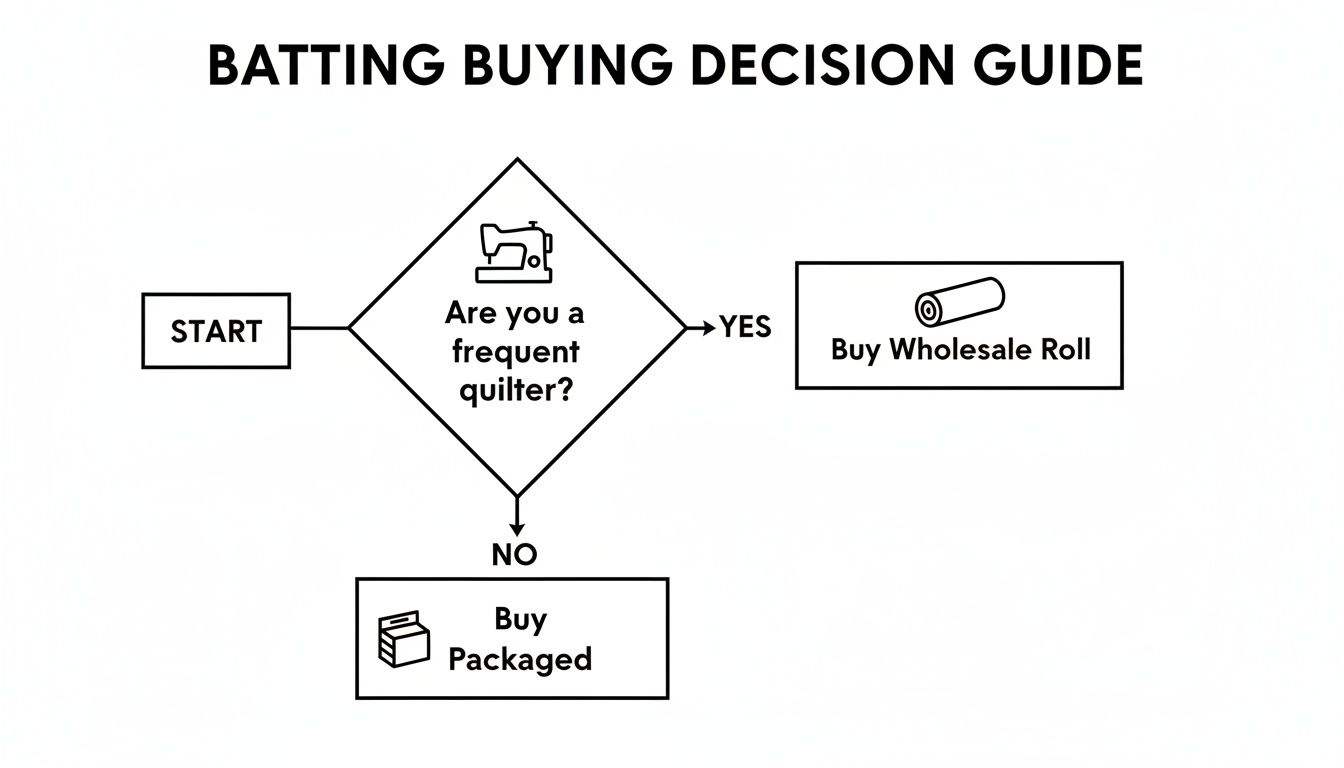
As you can see, the more quilts you finish, the smarter it is to invest in a full roll. It just makes financial sense. Now, let’s dig into the most popular options out there so you can feel confident in your choice.
The Classic Choice: 100% Cotton
For quilters who live for that traditional, slightly crinkled, antique look, 100% cotton batting is the undisputed champion. It’s a natural, breathable fiber that feels a bit like a thick flannel sheet, giving quilts a beautiful weight and softness that just gets better with every wash.
After that first trip through the laundry, it shrinks just a little, creating that gorgeous puckered texture that so many traditional quilters adore. This makes it perfect for heirloom quilts, bed quilts, and any project where you want a classic, breathable feel.
The Reliable Workhorse: 80/20 Cotton-Poly Blend
The 80/20 cotton-polyester blend is probably the most popular batting on the market today, and for very good reason. It truly offers the best of both worlds: you get the softness and breathability of cotton, but with the added strength and stability of polyester.
This blend is a true workhorse, built for quilts that will be loved and used every single day. The polyester adds just enough loft and resilience to resist wrinkles and hold its shape beautifully over time, making it a fantastic all-purpose choice for longarmers and home quilters alike.
Specialty Batting for Unique Projects
Beyond the two mainstays, a whole world of specialty battings can solve specific problems and add that perfect finishing touch. Each one is designed for a particular job.
-
Wool Batting: If you want your quilting stitches to really pop, wool is your secret weapon. It has a higher loft that creates incredible stitch definition, making it a favorite for show quilts. It’s also surprisingly lightweight yet incredibly warm—perfect for a cozy quilt that doesn’t feel heavy.
-
Black Batting: Have you ever noticed those tiny white fibers poking through your dark fabrics? That's called "bearding," and black batting is the simple, brilliant solution. Using a dark batting under your navy, black, or jewel-toned fabrics keeps the finish looking clean and professional.
-
Fusible Batting: This is a huge time-saver. It has a light, heat-activated adhesive on both sides, letting you fuse your quilt sandwich together with an iron. It completely eliminates the need for pins or spray basting, which is a lifesaver on smaller projects like table runners and wall hangings.
To help you sort through these options, I've put together a quick reference chart.
Wholesale Batting Roll Comparison Guide
This table breaks down the most common batting types to help you match the right material to your project's needs.
| Batting Type | Best For | Loft & Drape | Key Advantage |
|---|---|---|---|
| 100% Cotton | Traditional quilts, heirlooms, breathable projects | Low loft, soft drape, creates a crinkled texture after washing | All-natural fiber that gets softer over time. |
| 80/20 Blend | Everyday quilts, longarm quilting, versatile projects | Low-to-medium loft, stable drape | Combines cotton's softness with polyester's durability and low shrinkage. |
| Wool | Show quilts, warm-but-lightweight quilts | High loft, excellent drape | Provides exceptional warmth and makes quilting stitches pop. |
| Black 80/20 | Quilts with dark or black fabrics | Low-to-medium loft, stable drape | Prevents white fibers from showing through dark fabrics. |
| Fusible 80/20 | Small projects, wall hangings, table runners | Low loft, slightly stiffer drape until washed | Eliminates the need for pinning or spray basting. |
Choosing the right foundation is everything. If you want to dive even deeper, check out our complete guide on the different types of quilt batting. It’ll give you all the details you need to select the perfect roll for your studio.
Calculating Your Needs To Maximize Value
Staring down a full 30-yard roll of batting can feel like a huge commitment. But with a little bit of smart math, that big purchase transforms into a savvy, calculated investment. The trick is to stop seeing one giant roll and start picturing it for what it really is: a whole stack of perfectly sized batting pieces, ready and waiting for all your future quilts.
Let’s walk through exactly how to figure out your roll's "yield" so you can buy with total confidence.
The process is way more straightforward than you might think. Once you know how many quilts you can get from a single roll, you can nail down your true cost-per-quilt. That simple number changes everything, turning a big expense into a strategic move that saves you serious money in the long run.
The Basic Formula For Calculating Yield
First things first. A standard wholesale roll of batting is typically 30 yards long. Since we measure our quilts in inches, we need to get everything in the same unit to make the math work.
Here’s the simple formula we'll use:
(Total Roll Length in Inches) / (Length Needed Per Quilt in Inches) = Number of Quilts Per Roll
Since there are 36 inches in a yard, that 30-yard roll gives you a grand total of 1,080 inches of batting to play with (30 yards x 36 inches/yard). Remember that number—it's the starting point for all your calculations.
Putting The Math Into Practice
Let's ground this in a real-world example. Say you love making queen-size quilts, which often finish around 90" x 108". You're eyeing a 120-inch wide roll of batting—a perfect choice since it easily covers the 108" side of your quilt.
Now, we just need to figure out how much length you need for each quilt.
- Quilt Top Length: Your queen quilt top is 90 inches long.
- Add Overage: This is critical. You absolutely must add extra batting on all sides. For longarm quilters, this overage is what you use to attach the quilt to the machine's clamps. For everyone, it gives you breathing room to trim and square up the quilt perfectly after quilting. A good rule of thumb is adding 4 inches of overage on each side, which means your batting piece needs to be 8 inches longer and 8 inches wider than your quilt top.
- Total Length Per Quilt: So, for your 90-inch long quilt, you’ll need a 98-inch piece of batting (90" + 8" overage).
With that number, we can plug everything into our formula and find out the total yield from your 1,080-inch roll:
- 1,080 inches (Total Roll Length) / 98 inches (Length Per Quilt) = 11.02 quilts
Just like that, you know you can confidently get 11 full queen-size quilts from a single wholesale roll, with a little scrap left over for a pillow or a fun mini-project. Suddenly, that big roll doesn't seem so intimidating anymore, does it?
You can also explore our detailed breakdown of common quilt batting sizes to help plan for all the different projects you have in mind.
Why Overage Is Non-Negotiable
It can be tempting to skimp on the overage to try and squeeze one more quilt out of a roll, but trust me, this is one corner you never want to cut. Think of that extra buffer as your insurance policy against some very frustrating (and costly) mistakes.
- For Longarmers: You simply need that extra material to load the quilt onto the frame properly. Without it, you risk the whole thing shifting, leading to puckers and tension problems.
- For Domestic Machine Quilters: Even when you're quilting on a home machine, things can shift. The overage guarantees that even if the top or backing moves a bit, your quilt top will stay fully covered by batting.
- For Squaring Up: After all that quilting, the edges are rarely perfect. That overage gives you the clean margin you need to trim everything down for a crisp, professional finish before you add the binding.
By taking a few minutes to calculate your needs and always factoring in the right overage, you turn a bulk purchase into a powerful tool for savings and efficiency. You'll know exactly what you’re getting, how long it will last, and the true value it brings to your craft.
Getting Started with Wholesale Buying
Deciding to buy quilt batting by the roll is a big step, but a smart one. So, what comes next? Think of it like getting a backstage pass to the quilting world—it's a little different from just walking into a retail shop, but once you know the lingo, you'll be navigating it like a pro.
This isn't just about clicking "add to cart." Buying wholesale is a strategic business move that helps you control your costs and keep your studio stocked. Getting comfortable with how suppliers operate will give you the confidence to order exactly what you need, when you need it, without any last-minute surprises.
Talking the Talk: Key Wholesale Terms
The first time you browse a wholesale site, you'll probably run into a few unfamiliar terms. The big one you'll see everywhere is Minimum Order Quantity, or MOQ.
Basically, an MOQ is the smallest amount you can buy in one go. For batting, that's almost always one full roll. Suppliers set MOQs because shipping these large, heavy rolls is a whole different ballgame than mailing a small package. It just makes the process cost-effective for everyone involved.
Another term you'll want to know is pre-order. The most popular batting blends, like a classic Hobbs 80/20, can fly off the shelves. A pre-order lets you claim a roll from the next incoming shipment before it's even listed as "in-stock." It's a fantastic way to plan ahead, especially if you know you have a busy season or a big project coming up.
Takeaway: Don't let MOQs and pre-orders intimidate you. They're just industry-standard tools that help the whole supply chain run smoothly. Getting the hang of them means you can plan your inventory and never have that "oh no" moment when you're out of batting.
And it’s a great time to be in this business. The global quilt batting market is expected to jump from $2.0 billion in 2024 to $3.5 billion by 2035. This growth is all thanks to the boom in home crafting and a real desire for quality, natural materials. Learning the wholesale ropes is how you tap into that momentum. For a deeper dive, you can explore more projections about the quilt batting market's future.
The Nitty-Gritty: From Samples to Shipping
You wouldn't buy a car without a test drive, right? The same goes for committing to a 30-yard roll of batting. You need to know you love it first, and that’s where samples come in. Any good supplier will have a clear sample policy.
-
Get Your Hands on Samples: Never be shy about asking for samples. You absolutely have to feel the loft and see the drape for yourself. It’s the only real way to know if a batting will bring your vision to life, and a small investment now can save you a huge headache later.
-
Plan for Lead Times: "Lead time" is simply the time between placing your order and when it actually ships out. It could be a couple of days or a few weeks, especially if you're pre-ordering. Always find out the lead time so you can build it into your project schedule.
-
Get Ready for Freight: A giant roll of batting isn't showing up via your regular mail carrier. It's coming on a pallet, delivered by a freight truck. That means you'll need to have a clear, accessible space ready for a large delivery vehicle to drop it off.
By getting clear answers on samples, lead times, and shipping requirements, you take all the guesswork out of the process. A little bit of planning turns a potentially complicated purchase into a simple, predictable part of running your business. You'll be managing your supplies like a seasoned pro, ready for whatever creative inspiration strikes next.
Protecting Your Investment With Smart Storage
That giant roll of batting sitting in your studio is more than just material—it’s a valuable asset for your craft or business. And just like you wouldn't leave premium fabric exposed to the elements, your quilt batting wholesale rolls deserve the same level of care. Let's be honest, proper storage is the only way to protect its loft, cleanliness, and overall quality from the first cut to the very last yard.
Think of batting as a sponge, just waiting to absorb whatever is in its environment. Its biggest enemies? Compression, moisture, dust, and pests. Leaving a roll on a concrete floor, for instance, is a recipe for disaster. It risks moisture wicking up and creating mildew, a problem that is nearly impossible to fix. Stacking heavy items on top is just as bad, as it can permanently flatten the fibers and ruin the very loft you paid for.
Creating The Ideal Storage Environment
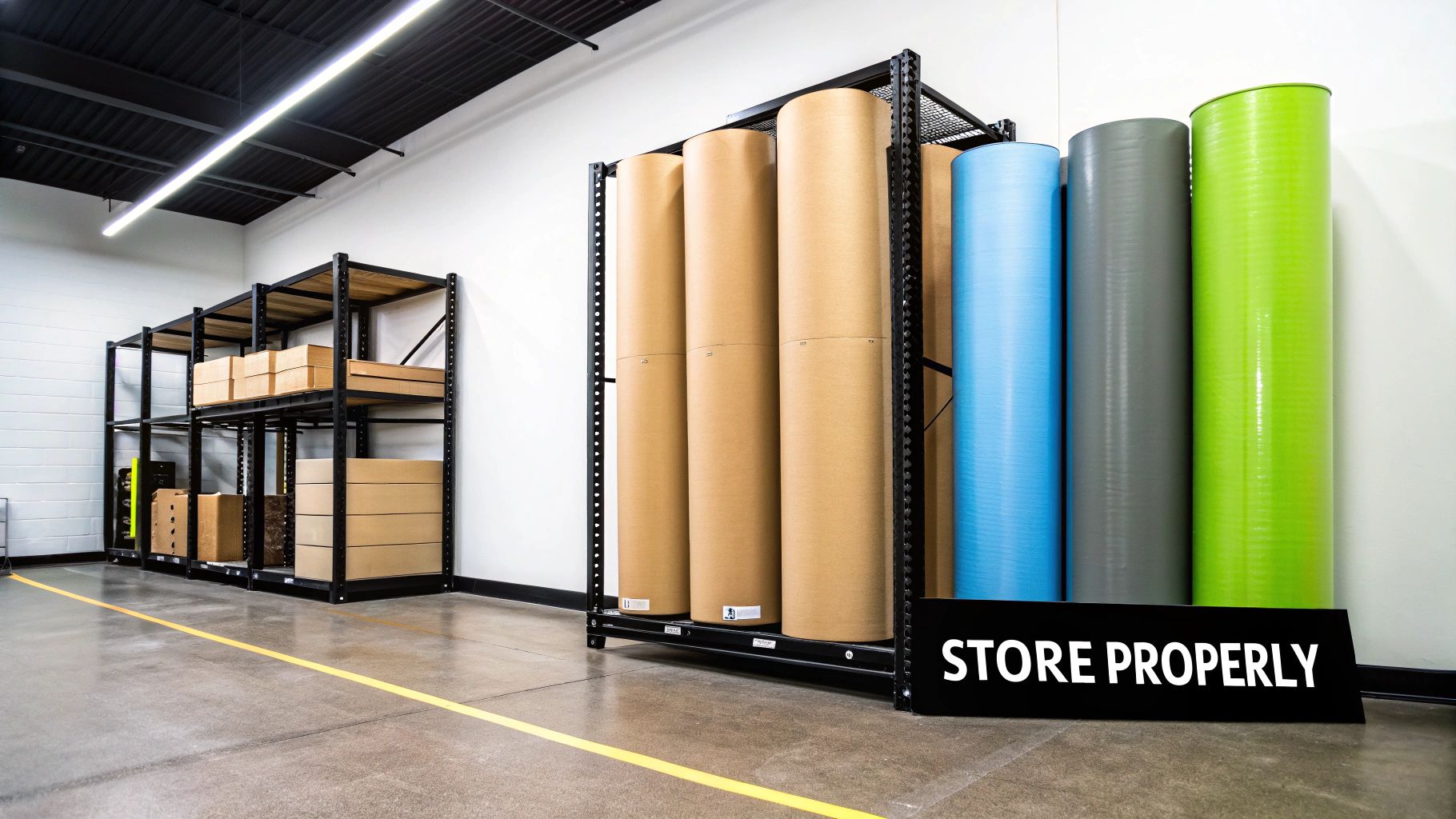
So, what's the perfect home for your batting roll? It’s pretty simple: keep it cool, dry, and off the floor. Basements and garages can be risky due to humidity fluctuations, so a climate-controlled space like a closet or a dedicated studio corner is a much safer bet. We recommend keeping the original plastic sleeve it was shipped in—it’s an excellent first line of defense against dust and dirt.
The goal is to preserve the batting's natural state. Every precaution you take ensures that the last yard of the roll is just as fluffy, clean, and ready to use as the first yard was.
For those of us tight on space, storing the roll vertically is a brilliant solution. Standing it on its end minimizes its footprint and prevents the weight of the roll from creating flat spots over time. You could even look into wall-mounted rack systems designed for vinyl or fabric rolls. They work perfectly for batting and turn unused wall space into prime real estate.
Best Practices For Handling And Preparation
Your job isn't over once you've cut a piece off the roll. Batting develops a "memory" from being wound so tightly, which shows up as wrinkles and creases. Trying to fight these wrinkles while quilting often leads to frustrating puckers and an uneven finish.
Luckily, the solution is simple: let the batting rest.
Here’s a process we swear by:
- Cut Your Piece: Measure and cut the amount of batting you need for your project, making sure to include your usual overage.
- Let It Relax: Lay the piece out flat. A spare bed, a large clean table, or even draped over the back of a sofa works great.
- Give It Time: Allow it to rest for at least 24 hours. This gives the fibers time to decompress and the wrinkles to naturally fall out.
If you have some stubborn creases, you can toss the batting piece in a dryer on a low-heat or air-fluff setting for about 10-15 minutes. Add a couple of dryer balls to help gently fluff the fibers back to life. It also helps to understand the structure of your specific batting, like whether it has a stabilizing layer. If you're curious, you can learn more by reading our guide explaining what scrim is in batting.
By following these simple storage and handling tips, you’re making sure your investment remains a high-quality asset, ready to become the heart of your next beautiful quilt.
Why Buying Batting By The Roll Is A Game Changer
Deciding to buy your quilt batting by the roll is a real turning point. It's not just about getting a better price per yard—it’s about completely changing how you approach your quilting, whether it’s a passion or a business. You’re moving from buying batting whenever you need it to having a smart, well-stocked studio that keeps you creating without interruption.
Think about what that actually means for your day-to-day. If you're a longarmer, it means no more hitting the brakes on a client's quilt to wait for a batting order to arrive. For a quilt shop owner, it’s the confidence that comes from knowing you’ve always got top-quality batting on hand for your customers.
From Expense To Investment
And for the dedicated home quilter? It's the simple, wonderful feeling of being ready for the next creative spark. You're no longer hemmed in by the precut sizes at the fabric store. You can cut exactly what you need for that massive king-sized quilt or a tiny wall hanging, which means less waste and more quilt for your money. My hope is that this guide has given you everything you need to choose the right batting, buy it like a pro, and care for it properly.
It's time to stop thinking of a roll of batting as a big expense. See it for what it is: a strategic investment in your craft and your creative future. Every roll you buy is a vote of confidence in your own work.
This mindset is perfectly in step with what's happening in the larger crafting world. The finished quilt market was valued at a staggering $5.32 billion in 2024, which just goes to show how much demand there is for quality materials. As more people embrace home decor and sustainable crafts, having a reliable supply of batting is no longer a luxury—it's essential. You can discover more insights about the quilt market and see where things are headed.
Unlocking Your Full Potential
At the end of the day, buying wholesale is about letting you do your best work. Your quilts will have a more consistent feel, your workflow will be smoother and more predictable, and you'll free up money to invest in other things you love, like beautiful fabric or a new machine.
You now know how to figure out your needs, navigate the buying process, and protect your investment with smart storage. You’re ready to make a choice that will not only help your bottom line but will fundamentally improve the way you create. Welcome to a more efficient, prepared, and creatively free way of quilting.
A Few Final Questions About Wholesale Batting
Even after you've done all the research, making the jump to buying quilt batting by the roll can feel like a big step. It's a major purchase, and you want to be completely sure it's the right move. Let's walk through some of the most common questions and hesitations I hear from quilters and shop owners.
My goal here is to tackle those practical last-minute concerns—from justifying the cost to figuring out where on earth you'll store the thing. Once you have all the facts, you can make a smart, confident decision that serves both your creativity and your wallet.
Is Buying a Full Roll of Batting Really Cheaper?
Yes, and the difference is bigger than you might think. While the initial investment for a full roll is higher than grabbing a single package off the shelf, the price you pay per yard plummets. For anyone who quilts more than a couple of times a year, the savings add up incredibly fast.
Think of it like this: you can buy snacks from a vending machine or you can buy them in bulk from a warehouse store. The vending machine is convenient for one-off cravings, but the per-item cost is sky-high. Buying in bulk costs more upfront, but your cost for each item is a fraction of the price. Over time, that difference can mean hundreds of dollars back in your pocket—money you can pour right back into your fabric stash.
And don't forget the hidden savings. You're not paying for shipping over and over again, and you're not spending time placing multiple small orders. It just simplifies everything.
How Can I Store a 30-Yard Roll in a Small Space?
This is probably the number one worry I hear, especially from quilters working out of a home studio. But trust me, it's more manageable than it looks. The secret is to think vertically. Stand the roll on its end, and suddenly its footprint shrinks, allowing you to tuck it into a closet, behind a door, or in a quiet corner of your room.
I've seen some wonderfully clever solutions from quilters working in tight spaces:
- Hang onto the plastic: That plastic sleeve the roll comes in? It’s your best friend. Keep it on to protect your batting from dust, moisture, and curious pets.
- Build a simple wall dispenser: A couple of sturdy closet rod brackets mounted on the wall can hold the roll horizontally, getting it completely off the floor and out of the way.
- Don't stack on it: This is the golden rule. Never, ever pile heavy things on top of your batting roll. It will compress the fibers, create permanent flat spots, and ruin that beautiful, even loft you paid for.
By taking advantage of vertical space, you can fit a full roll into just about any studio without giving up precious floor real estate. Just keep it clean, dry, and uncompressed.
What’s the Difference Between Batting on a Roll Versus a Board?
The batting itself is exactly the same high quality. The only real difference is the packaging and the amount of yardage you're getting. It all comes down to your storage preference and how much you need.
A roll is simply the batting wound around a sturdy cardboard tube. This is the best way to prevent hard creases, which makes it the standard for larger quantities like a full 30-yard or 40-yard length. If you're a longarmer or a prolific quilter, this is what you want.
A board, on the other hand, is batting that has been carefully folded around a flat piece of cardboard. This creates a neat, rectangular package that’s often easier to ship and can be stored flat—think under a bed or on a deep shelf. Boards are typically used for smaller wholesale amounts, like 15 yards.
Can I Mix Batting Types to Meet a Minimum Order?
That's a fantastic question, but the answer really depends on the supplier. Some wholesale distributors are pretty strict and require their Minimum Order Quantity (MOQ) to be met with a single type of product—one full roll of Hobbs 80/20, for example.
Thankfully, many other suppliers—especially those who work closely with small businesses and home quilters—are much more flexible. They might let you combine different types of batting, or even mix in other quilting supplies, to hit a certain dollar amount for your first order. The only way to know for sure is to check their terms or just ask. A quick email or phone call will clear things up and help you put together the perfect order for your needs.
Ready to unlock the savings and creative freedom that come with buying in bulk? At Quilt Batting, we make it simple to stock your studio with the brands you already know and trust. Take a look at our collection of batting by the roll and find the perfect foundation for your next masterpiece. Shop our wholesale batting rolls today!