

So, you’ve pieced together a beautiful quilt top. Now what? The real magic—the quilting itself—is what transforms those layers of fabric and batting into a cozy, textured masterpiece. At its heart, quilting is simply stitching through the "quilt sandwich" (your top, batting, and backing), but how you do it makes all the difference.
The three big players in the quilting world are hand quilting, domestic machine quilting, and longarm quilting. Each has its own rhythm, its own set of tools, and its own unique charm. Think of them as different paths to the same beautiful destination.
Your Journey Through the World of Quilting
Welcome to one of the most rewarding parts of making a quilt! This guide is your friendly map to navigating these different techniques. We'll get into the nitty-gritty of each one, from the quiet, meditative pace of hand stitching to the high-speed power of a longarm machine.
My goal here is to help you find the method that just clicks with you and your project. To get started, let's look at the big picture.
This simple map lays out the three main approaches.
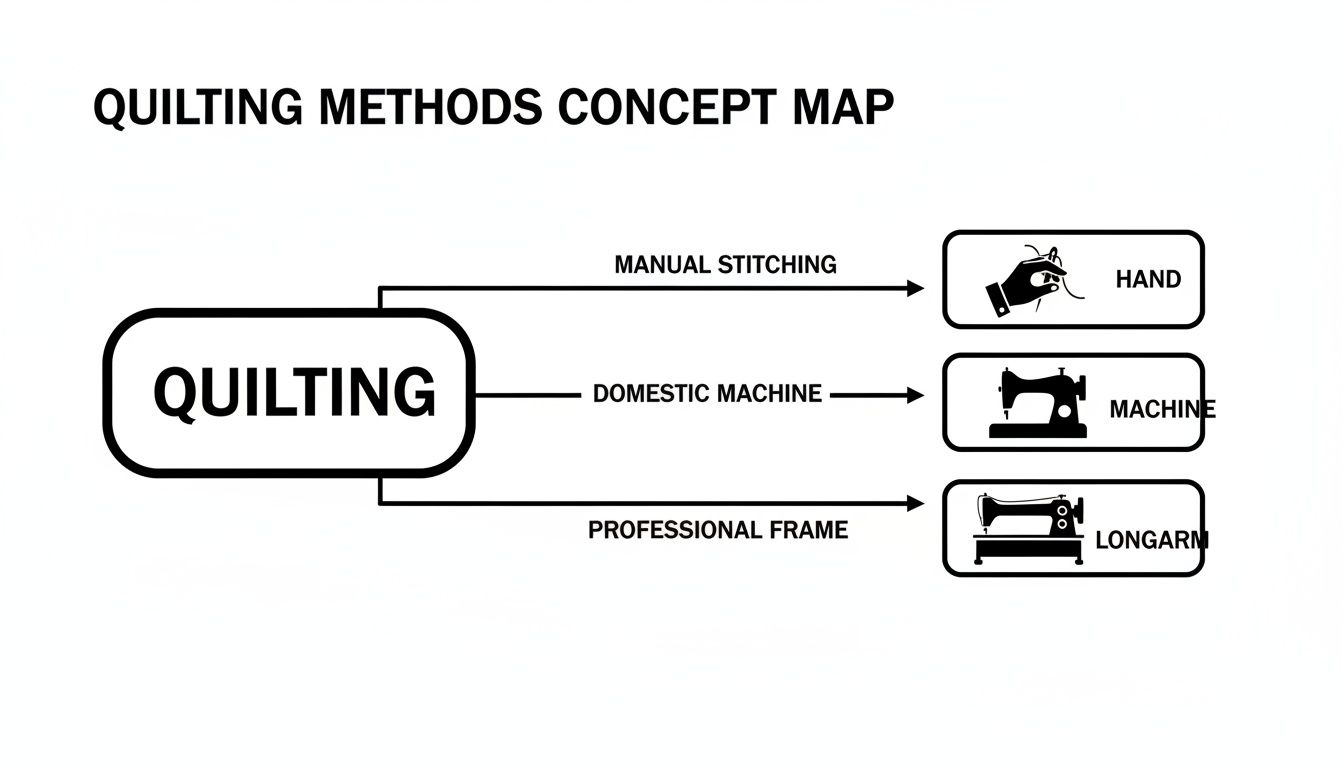
Many quilters start with what they have—their hands or their home sewing machine—and some eventually move on to bigger equipment. But plenty of us happily stick with one method or jump between all three depending on the quilt.
To help you see the options at a glance, here’s a quick breakdown of the primary methods we'll be exploring.
Quick Guide to Quilting Methods
| Quilting Method | Core Characteristic | Best For |
|---|---|---|
| Hand Quilting | Slow, meditative, and creates a soft, traditional texture. | Heirloom quilts, small projects, and creating a classic hand-made look. |
| Machine Quilting | Done on a home sewing machine; versatile and much faster than by hand. | Quilters on a budget, smaller projects, and detailed free-motion work. |
| Longarm Quilting | Uses a large, specialized machine for fast and precise quilting. | Large quilts (queen/king), quilters with limited time, and complex designs. |
This table is just a starting point. As you'll see, the lines between these methods can blur, and the best choice often comes down to personal preference.
Finding Your Creative Rhythm
There's no "right" or "wrong" way to quilt. The real question is, what kind of experience are you looking for? Do you love the feel of needle and thread in your hands, creating one stitch at a time? Or does the idea of finishing a king-sized quilt in a weekend sound like a dream come true? Your answer will point you in the right direction.
You're joining a craft that's bigger and more exciting than ever. The quilting industry is a $4.5 billion global community with up to 11 million passionate makers. What’s really cool is that a recent survey found that 18% of quilters are brand new to the craft, proving it’s not just for our grandmothers anymore. You can see more fascinating numbers in the 2025 quilting trends survey.
The "best" method of quilting is the one that brings you the most joy and helps you finish your project. The beauty of the craft lies in its versatility—there's a technique for every personality, timeline, and artistic goal.
What to Expect in This Guide
Whether you’re threading your first needle or looking to try something new, we've got you covered. In the sections ahead, we’ll dive deep into each method, covering:
- The essential tools you'll need to get started.
- Tips for picking the perfect batting for your project.
- Clear, step-by-step guidance to build your skills.
If you want a primer on the absolute basics first, you can check out our guide on how to quilt. Now, let’s get ready to turn that beautiful fabric into a true work of art.
The Meditative Art of Hand Quilting
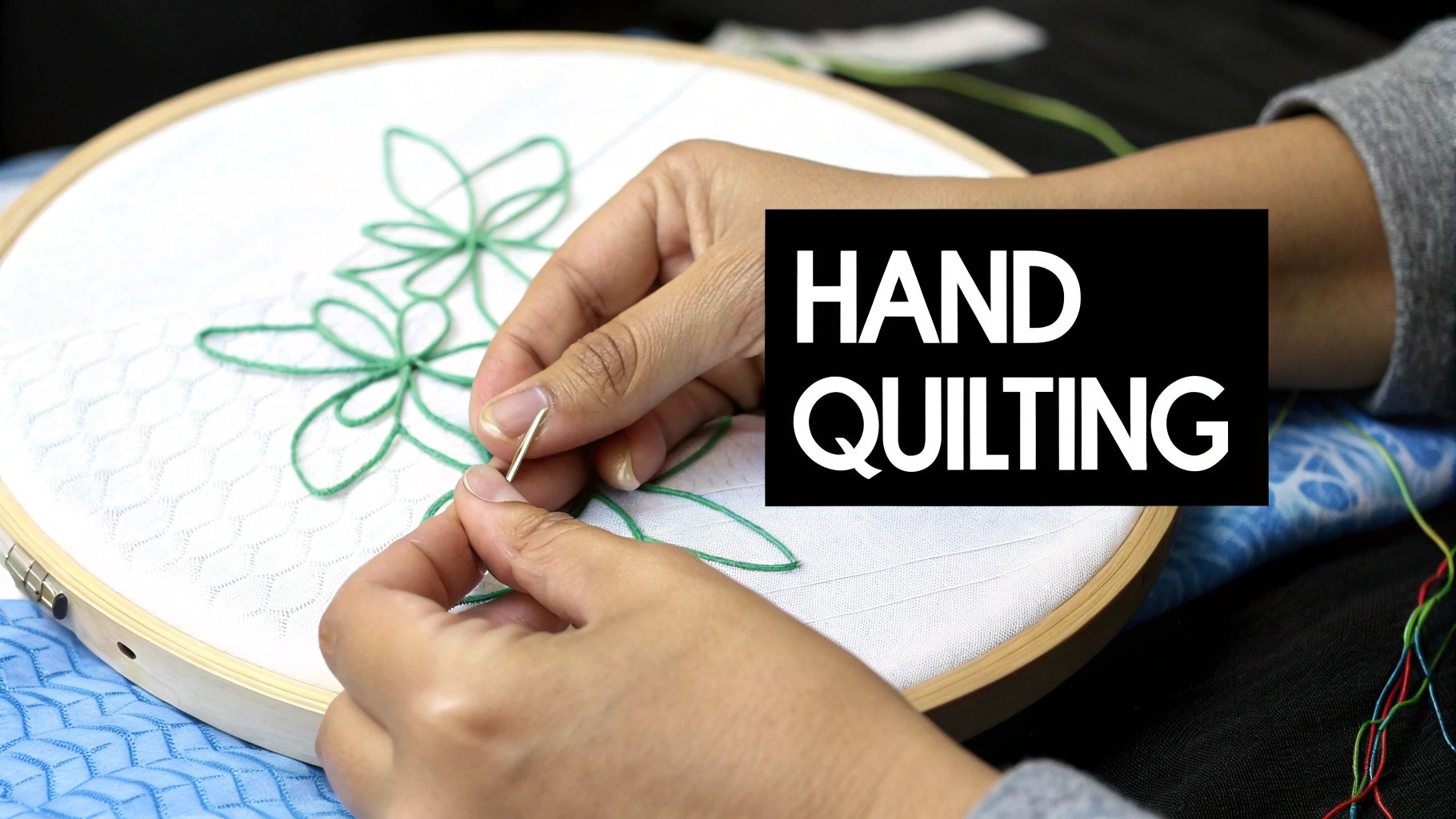
There’s something truly special about creating a cherished heirloom one deliberate stitch at a time. That’s the heart of hand quilting, the original method that connects us to the long and beautiful history of this craft. It's a rhythmic, personal journey that turns a simple quilt top into a soft, textured masterpiece with just a needle and thread.
Unlike the hustle of machine work, hand quilting is an invitation to slow down. Each stitch is a tiny moment of intention and quiet focus. This technique is famous for the incredible softness and gentle drape it gives a finished quilt—a cozy quality that machines just can't seem to replicate.
Core Hand Stitching Styles
When you first dip your toes into hand quilting, you’ll find two main ways to stitch. Think of it like choosing between writing in cursive or print; both get the words on the page, but the feel of the motion and the final look are completely different.
- The Rocking Stitch: This is the classic, fluid technique you might picture. You use a thimble to push the needle down through the quilt layers and then "rock" it back up in one smooth movement. You can load several stitches onto the needle at once before pulling the thread through, which makes it surprisingly efficient and creates that beautiful, classic look.
- The Stab Stitch: When you need pinpoint accuracy, especially for quilting around tricky appliqué shapes or detailed patterns, the stab stitch is your best friend. You literally push the needle straight down through all the layers with one hand and pull it all the way through from the back with your other hand. Then you repeat the process coming back up. It’s slower, sure, but the control you get is second to none.
Hand quilting is less about speed and more about connection—to the fabric, to the process, and to the person who will one day wrap themselves in your work. Those little puckers left by each stitch, affectionately called "quilter's freckles," are the unique signature of a piece made with love and patience.
Essential Tools for Success
While hand quilting is simple in concept, having the right tools makes all the difference. These aren't just fancy accessories; they are partners in the process that make your work more comfortable, enjoyable, and professional. Investing in a few key items will save your hands and seriously improve your stitch quality.
Your basic toolkit should include:
- A Quality Thimble: This is absolutely non-negotiable. A good thimble protects your finger as you push the needle, saving you from soreness and helping you apply steady, even pressure for perfect stitches.
- 'Between' Needles: Don't just grab any old needle. These are short, strong, and specifically designed for hand quilting. Their small size is the secret to making those tiny, even stitches that everyone admires.
- A Quilting Hoop or Frame: A hoop or frame keeps your quilt sandwich pulled taut, which is a game-changer for getting the needle to pass through the layers cleanly. It’s like having a third hand holding your work steady.
Choosing the Best Batting
The soul of a hand-quilted project is truly its batting. The goal is to find a batting that’s easy to needle, which just means your needle can glide through it without a fight. A dense, stiff batting will just lead to sore fingers and a lot of frustration.
For that classic, soft feel that really lets your stitches shine, 100% cotton or a high-quality wool batting is the way to go. These natural fibers are breathable, have a lovely low loft that’s a dream to work with, and create that gorgeous, crinkly antique look after the first wash. You can learn more by exploring different hand quilting designs and their best pairings to see just how much the batting choice affects the final texture.
It’s a timeless method, and for good reason—it brings an unparalleled character and warmth to every single project.
Mastering Your Domestic Sewing Machine
Ready to take your quilting to the next level? Your trusty home sewing machine is more than just a tool for piecing blocks together—it’s a powerhouse for finishing your quilt with speed and precision. This is where you can blend the thoughtful control of hand quilting with a much faster turnaround, and it's often where quilters really begin to develop their signature style.
The beauty of quilting on your domestic machine is its incredible versatility. You can lay down crisp, modern geometric lines or dance across the surface with intricate, flowing swirls—all without needing a massive, dedicated machine.
Let's dive into the two main ways you can tackle this.
Straight-Line Quilting With a Walking Foot
Think of a walking foot as an all-terrain vehicle for your sewing machine. This brilliant attachment has its own set of feed dogs on top that move in perfect sync with the machine's feed dogs below. What does that mean for you? It means all three layers of your quilt sandwich—the top, batting, and backing—are pulled through the machine evenly, at the exact same pace.
This simple piece of engineering is a total game-changer. It’s your secret weapon against the dreaded puckers, pulls, and shifting that can otherwise plague a project. With a walking foot, you can achieve flawlessly professional straight and gently curved lines with confidence.
A few classic designs you can master with a walking foot:
- Grid Patterns: Timeless crosshatching or diamond grids that add beautiful texture and structure.
- Stitch-in-the-Ditch: Hiding your stitches right in the seam lines of your blocks, which makes the piecing, not the quilting, the star of the show.
- Echo Quilting: Stitching lines that follow, or "echo," the shapes of your pieced designs to create a lovely ripple effect.
Because it's so straightforward, this is hands-down one of the best methods for beginners to build confidence and get fantastic results right away.
Free-Motion Quilting With a Darning Foot
If straight-line quilting is like painting with a ruler, then free-motion quilting (FMQ) is like sketching with a pen. This is where you get to take full artistic control. To get started, you'll pop on a darning foot (or a special FMQ foot) and—this is the crucial part—lower or cover your machine's feed dogs.
With this setup, the machine no longer pushes the fabric forward. Instead, you are in the driver's seat. You guide the quilt under the needle in any direction you wish—forward, backward, sideways—essentially drawing your designs with thread.
Free-motion quilting turns your sewing machine into an artist's tool. The stitch length isn't set by the machine anymore; it’s created by the rhythm between your hands moving the fabric and the speed of the needle. It's a real dance between you and your machine.
This technique opens up a whole world of creativity, from simple meanders and loops to stunningly complex feathers, flowers, and custom motifs.
Setting Up for Success
No matter which style you choose, a little prep work goes a long way. You’ll be wrangling a pretty bulky quilt, so giving yourself the right support is absolutely key to staying in control.
- Extension Table: This is a non-negotiable for me. An extension table slides around your machine's sewing bed to create a much larger, flat surface. It stops the weight of the quilt from dragging against the needle and distorting your stitches.
- Quilting Gloves: These might seem like a small thing, but they make a huge difference. Specialized quilting gloves have grippy fingertips that give you incredible control over the fabric, so you can guide it smoothly instead of fighting with it.
- The Right Needle: Always, always start with a fresh needle! A size 90/14 Quilting needle is a fantastic all-around choice. It’s specifically designed to pierce through those thick layers cleanly without shredding your fabric or the batting inside.
The Best Batting for Machine Quilting
When you're working on a domestic machine, the goal is to find a batting that gives you beautiful stitch definition without being too thick to wrestle through the machine's throat space.
An 80/20 cotton-poly blend is the workhorse batting for countless quilters, and for good reason. The 80% cotton gives it that soft, breathable feel we love, while the 20% polyester adds just enough stability and loft to make your stitches pop. It drapes beautifully, is a dream to manage under the needle, and holds up incredibly well to washing and use.
To take it a step further, you can learn more about selecting machine quilting threads that will perfectly complement your batting choice and make your designs shine.
The Power and Precision of Longarm Quilting
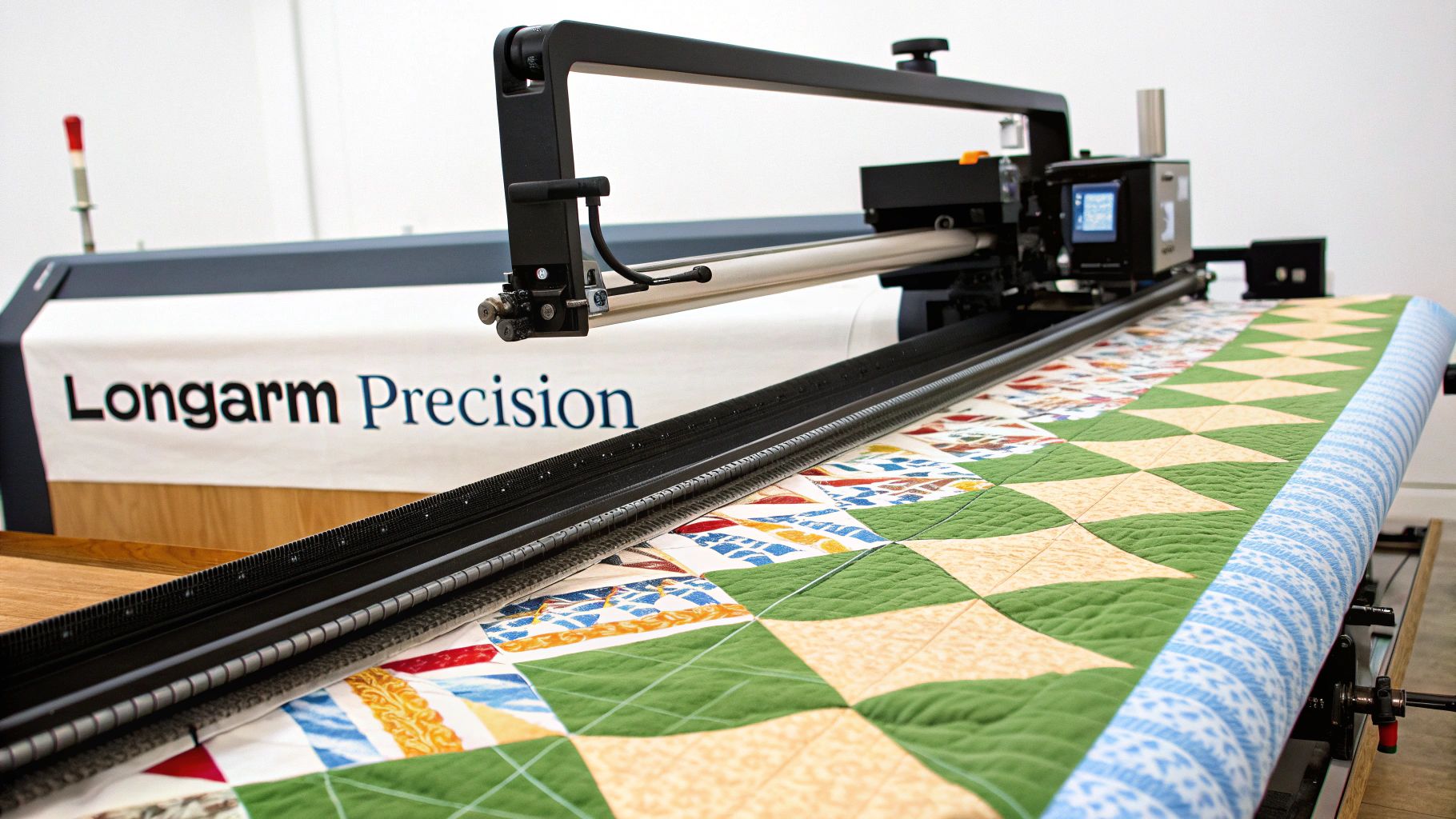
Imagine flipping your entire quilting process upside down. Instead of fighting to maneuver a heavy quilt sandwich under the tiny needle of your home sewing machine, what if the machine itself moved? That's the revolutionary idea behind longarm quilting.
A longarm setup features a huge sewing head that glides over your quilt top, which is stretched perfectly flat and smooth on a large frame. This completely changes the game. It takes the physical wrestling match out of quilting, opening the door to a level of speed, precision, and scale that's just not possible otherwise.
Hand-Guided vs. Computer-Guided Systems
Once you get into longarming, you'll find there are two main ways to run the machine. Each offers a completely different experience and is suited to different creative goals.
-
Hand-Guided Longarm Quilting: This is pure, free-motion artistry on a grand scale. You stand at the machine, holding onto handles that let you physically steer the sewing head across the quilt. This gives you total creative freedom to draw with thread, whether you're creating swirling feathers, custom motifs, or echoing the piecing in your quilt top. It’s your vision translated directly into stitches.
-
Computer-Guided Longarm Quilting: Here’s where technology steps in to do the heavy lifting. With a computerized system, you choose a digital pattern, tell the machine where to stitch, and hit "go." It then executes the design with robotic precision. This is how you get those flawless, intricate, edge-to-edge patterns that look perfectly uniform across the entire quilt—a feat that’s incredibly difficult to achieve by hand.
Think of it this way: with a hand-guided system, you are the artist drawing the lines. With a computer-guided system, you're the director telling a very precise robot exactly what to draw.
Choosing the Right Batting for High Speeds
A longarm machine stitches at an incredible pace, which puts a lot of stress on your materials—especially the batting. You need something that can handle the speed without stretching, tearing, or "bearding" (when little fibers poke through your fabric).
This is why professional longarmers almost always use batting that comes on massive rolls, often 96 to 120 inches wide. Using one continuous, smooth piece ensures there are no bumps or inconsistencies, even on a massive king-sized quilt.
Here are the top batting choices for longarm quilting:
- High-Quality 80/20 Blends: This blend of 80% cotton and 20% polyester is the industry's go-to for a reason. You get the soft, classic feel of cotton, but the polyester adds just enough stability and loft to make the stitches pop without feeling stiff. It’s a true workhorse.
- Wool Batting: If you want your quilting to have incredible texture and definition, wool is a fantastic choice. It’s surprisingly lightweight, bounces back beautifully, and its natural loft creates a luxurious, puffy finish that makes every stitch look amazing.
Choosing the right materials is half the battle. If you want to learn more, you can explore our guide to what longarm quilting entails to get a deeper look at how these incredible machines operate. Whether you're thinking of renting time on a longarm or sending your quilt to a pro, understanding the fundamentals will help you get a stunning finish every time.
Exploring Creative Quilting Techniques
Once you've got the basics down, you open the door to a whole world of creative techniques. This is where quilting really gets fun. Think of these methods less as ways to finish an entire quilt and more as tools to add your unique signature, blending styles and injecting personal flair into every piece.
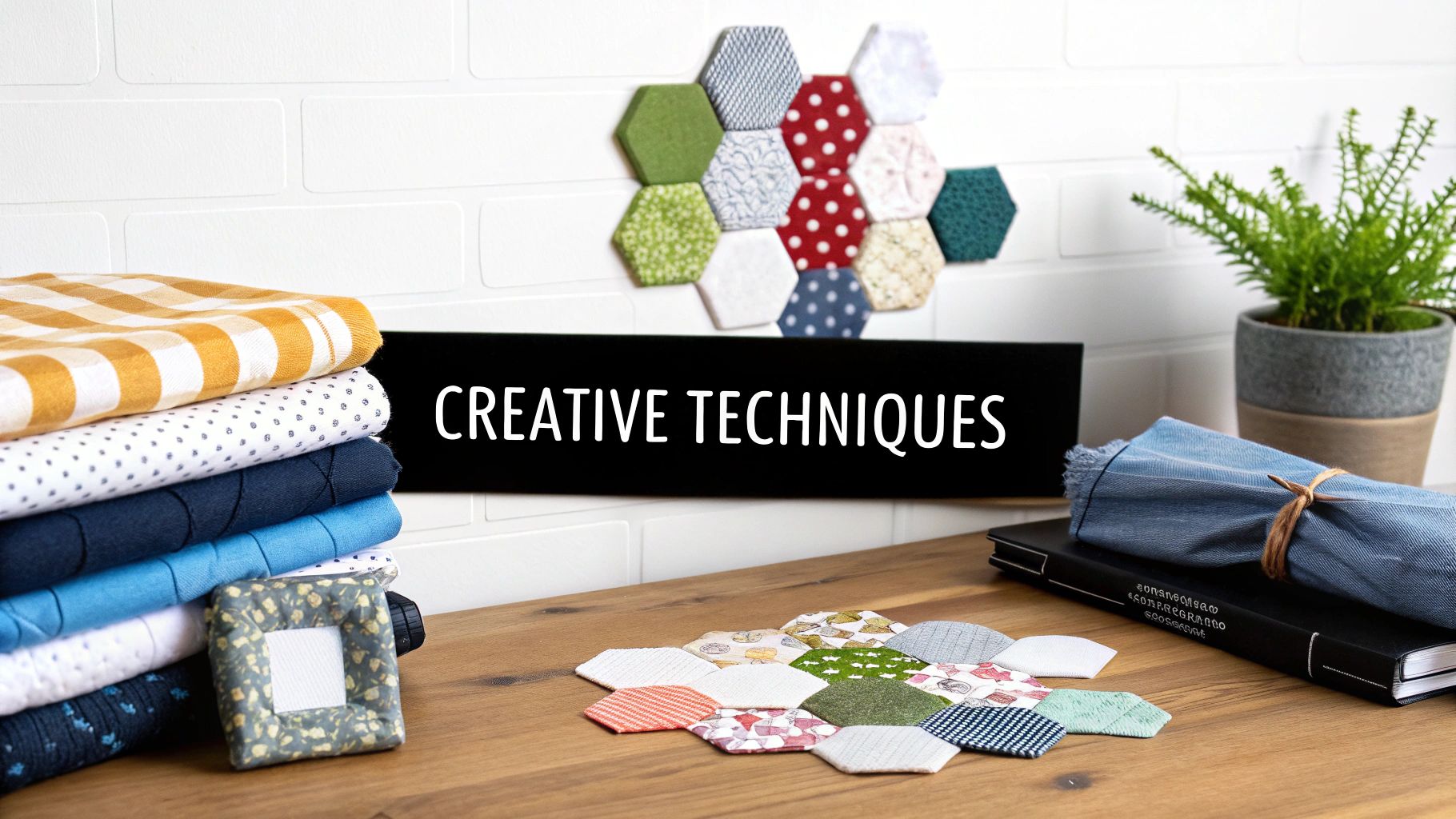
We're going to dive into four very different approaches: the rustic simplicity of tied quilts, the meticulous geometry of English paper piecing, the decorative art of appliqué, and the free-spirited vibe of modern quilting. Each has its own distinct personality, and learning them will open up incredible new possibilities for your projects.
The Charm of Tied Quilting
If you're after a fast, cozy, and wonderfully rustic finish, you can't beat tied quilting. Instead of stitching lines across the quilt, this method uses simple knots or ties—usually made from yarn or embroidery floss—to hold the three layers together. It’s an incredibly straightforward technique, perfect for your first quilt or when you just want a quick and satisfying project.
Tied quilts are famous for their plush, comfy feel. Since you aren’t compressing the batting with dense stitching, you can go for a high-loft polyester batting. This creates that wonderfully puffy, comforter-like quilt that’s perfect for snuggling under on a cold night.
The Precision of English Paper Piecing
Ever look at a quilt covered in perfect, interlocking hexagons and wonder how on earth anyone could piece them so precisely? The secret is almost always English Paper Piecing (EPP). This is a wonderfully accurate hand-sewing technique where you stabilize your fabric around paper templates before sewing the shapes together.
The process is pure genius:
- First, you baste or glue your fabric around a precisely cut paper shape (a hexagon is classic, but diamonds and other shapes work too).
- Next, you whipstitch the fabric-wrapped shapes together by hand, matching up the edges perfectly.
- Once all the shapes are joined, you simply pop the paper templates out from the back.
This method guarantees razor-sharp points and flawless seams, making it possible to create complex geometric patterns that would be a true nightmare on a machine. Better yet, it’s completely portable. It's the perfect project to toss in a bag and work on anywhere.
The Artistry of Appliqué
Appliqué is really just painting with fabric. It’s the art of layering smaller fabric shapes onto a larger background to create a picture or a beautiful design. It’s a versatile skill that can be done by hand for a soft, traditional look or with a machine for a crisp, durable finish.
- Hand Appliqué: This involves carefully turning the raw edges of your fabric shape under and using nearly invisible stitches to secure it to the background. The result is a beautifully soft and seamless effect.
- Machine Appliqué: For this method, shapes are often fused to the background with a fusible web first, then stitched down with a decorative stitch like a satin stitch or a blanket stitch. It’s much faster and creates a bold, graphic look.
When you're using appliqué, especially with a machine, a fusible batting can be your best friend. You can temporarily iron it into place, which helps stabilize all the layers and stops anything from shifting while you stitch down your decorative pieces.
The Freedom of Modern Quilting
Modern quilting isn't so much a single technique as it is a design philosophy—one that loves to break the old rules. It champions bold, graphic designs, improvisational piecing, and a dramatic use of negative space. This is where you intentionally leave large, open areas of background fabric, allowing the quilting stitches themselves to become a major design element.
This style often features minimalist color palettes, asymmetrical layouts, and fresh takes on classic quilt blocks. The quilting itself is frequently simple and geometric, like dense straight lines (often called "matchstick quilting") that add incredible texture and draw the eye. Modern quilting is all about encouraging you to play, experiment, and find your own unique voice.
Choosing the Right Batting for Your Quilting Method
The batting you choose can make or break your project, and the best choice often comes down to the quilting method you're using. A fluffy, high-loft batting that’s perfect for a tied quilt would be a nightmare for intricate machine quilting. This table will help you match your technique with the ideal batting to get the results you're looking for.
| Quilting Method | Recommended Batting Type | Key Benefits | Ideal Loft |
|---|---|---|---|
| Hand Quilting | 100% Cotton or Cotton/Poly Blend | Easy to needle, shows off stitch definition, soft drape. | Low |
| Machine Quilting | Cotton/Poly Blend or 100% Polyester | Resists bunching, stable, comes in various lofts. | Low to Medium |
| Longarm Quilting | Wool or Blended Batting | Excellent stitch definition, lightweight yet warm, resists creases. | Low to Medium |
| Tied Quilting | High-Loft Polyester | Creates a puffy, comforter-like feel; holds its shape well. | High |
| Appliqué | Fusible Batting | Stabilizes layers, prevents shifting during stitching. | Low |
| Modern Quilting | Cotton or Bamboo Blend | Creates a flat, modern drape; great for dense stitching. | Low |
Ultimately, the batting is the hidden soul of your quilt. The right choice supports your creative vision, making the quilting process smoother and ensuring your finished piece looks and feels exactly how you imagined.
Choosing Your Perfect Quilting Method
So, where do you go from here? We’ve walked through the gentle pace of hand quilting, the workhorse power of a domestic machine, and the dazzling precision of a longarm. We've even touched on wonderfully creative paths like appliqué and English Paper Piecing. Now comes the fun part: deciding which method to try first.
Let’s be clear—there’s no single “best” way to quilt. The right method is the one that feels right for you and for the project in front of you. It's an intimate choice that hinges on what you want to create, how much time you have, and what kind of creative journey you’re looking for.
Matching the Method to Your Vision
Think of your quilting style as the final, defining touch. It’s what gives your quilt its soul. Each technique brings something different to the table, creating a distinct texture and personality.
- For that soft, heirloom feel: Nothing beats hand quilting. Those subtle, hand-wrought stitches create a drape and puff that a machine just can’t replicate. It's pure tradition.
- For getting it done with control and flair: Your home sewing machine is your go-to. It offers a fantastic balance of speed for straight-line quilting and creative freedom for free-motion designs.
- For a show-quality finish on bigger quilts: This is where longarm quilting truly shines. It’s the key to achieving those intricate, edge-to-edge patterns with flawless precision, turning a large quilt from a challenge into a masterpiece.
- For pure artistic expression: Techniques like tied quilting, EPP, or freestyle modern quilting are all about breaking the mold. They let you infuse your work with a personality that's completely, uniquely yours.
The best quilting methods are the ones that you genuinely enjoy. The whole point is to find a process that brings you joy, not just another task to check off a list. Don't be afraid to experiment, play around, and even mix and match techniques on the same quilt!
It's Time to Start Stitching
You've officially left the starting line. All this knowledge is now your personal toolkit, ready to be put to use. The only thing left to do is dive in.
Pick a method that genuinely excites you. Grab the right batting for the job from a reliable place like Quilt Batting to give your project the foundation it deserves. With a head full of ideas and a boost of confidence, you’re ready to start making something beautiful.
Got Questions About Quilting? We've Got Answers.
Diving into quilting often brings up a flood of practical questions. It's totally normal. Choosing a technique can feel like a huge commitment, but a little expert advice can make the path forward much clearer. This is where we get down to brass tacks.
Let's move past the theory and tackle the real-world "how" and "why" behind picking a quilting method that truly fits you, your goals, and where you are on your creative journey.
What’s the Absolute Best Way for a Beginner to Start?
When you're new to quilting, the name of the game is getting a win. You want to build momentum and end up with something you're proud of. For that reason, I always recommend straight-line quilting with a walking foot on your home sewing machine.
It's the most accessible starting point, hands down. You don't need a fancy new machine, and it delivers a clean, modern look that's incredibly satisfying.
A walking foot is a game-changing attachment that grips all three layers of your quilt "sandwich" and feeds them through the machine evenly. This little workhorse prevents the puckering and shifting that drives so many beginners crazy. Stick to simple straight lines, and you'll get a beautiful finish while learning how your machine handles the bulk of a quilt.
Is It Okay to Mix and Match Quilting Methods?
Absolutely! In fact, that's where the real magic can happen. Combining different techniques in one quilt is a fantastic way to create texture, depth, and a ton of visual interest. It’s like an artist using both charcoal and watercolor in the same piece—each one brings its own unique vibe to the party.
Here are a few combinations quilters love:
- Machine & Hand Quilting: You could machine quilt around your main design elements for speed and stability, then go back in and add delicate hand-stitched details to make certain areas pop with a soft, heirloom feel.
- Longarm & Hand Quilting: It's very common to have a longarmer stitch an all-over pattern to secure the quilt, and then you can add your own special hand-quilting around a focal point, like a beautiful appliqué block.
- Tied & Machine Quilting: For a cozy, rustic quilt, you might tie the center for that classic puffy look, then run a simple machine-stitched border around the edge for durability.
How in the World Do I Choose the Right Batting?
The loft of your batting—basically, its thickness—dramatically changes the final look and feel of your quilt. The right choice depends entirely on the quilting style you're going for.
Here's a simple rule of thumb I always share: the more stitches you plan to add, the lower the loft should be. Trying to push a thick, fluffy batting through a sewing machine for dense quilting is a recipe for frustration, and it will swallow up all your beautiful stitch work.
Low-loft battings, like a 100% cotton or an 80/20 blend, are your best friends for hand quilting or intricate machine quilting. They create a flat, soft drape that really shows off your stitches. On the flip side, a high-loft polyester batting is perfect for tied quilts where the goal is a thick, cushy, comforter-like finish.
What Tools Do I Really Need to Get Started?
The world of quilting gadgets is a glorious rabbit hole, but you only need a handful of essentials to get started with machine quilting. Seriously, don't feel like you have to buy out the entire store!
Here is your must-have starter kit:
- A Rotary Cutter, Mat, and Ruler: This trio is non-negotiable. It's the key to cutting accurate pieces quickly and, most importantly, safely.
- A Walking Foot: Like I said before, this is your secret weapon for frustration-free machine quilting.
- Machine Quilting Needles: A fresh, sharp needle (a size 80/12 or 90/14 is a great place to start) designed for quilting makes a world of difference.
- Quality Cotton Thread: You can't go wrong with a good, 50-weight cotton thread in a neutral color. It’s perfect for both putting your top together and the quilting itself.
With just these four things, you have everything you need to take your first quilt from a stack of fabric to a finished project.
Here at Quilt Batting, we know from experience that the right foundation can make or break a quilt. From the perfect low-loft cotton for your first machine-quilted project to plush, dreamy rolls for your longarm, we have the high-quality batting you need to bring your vision to life. Find the perfect roll for your next masterpiece on our site.